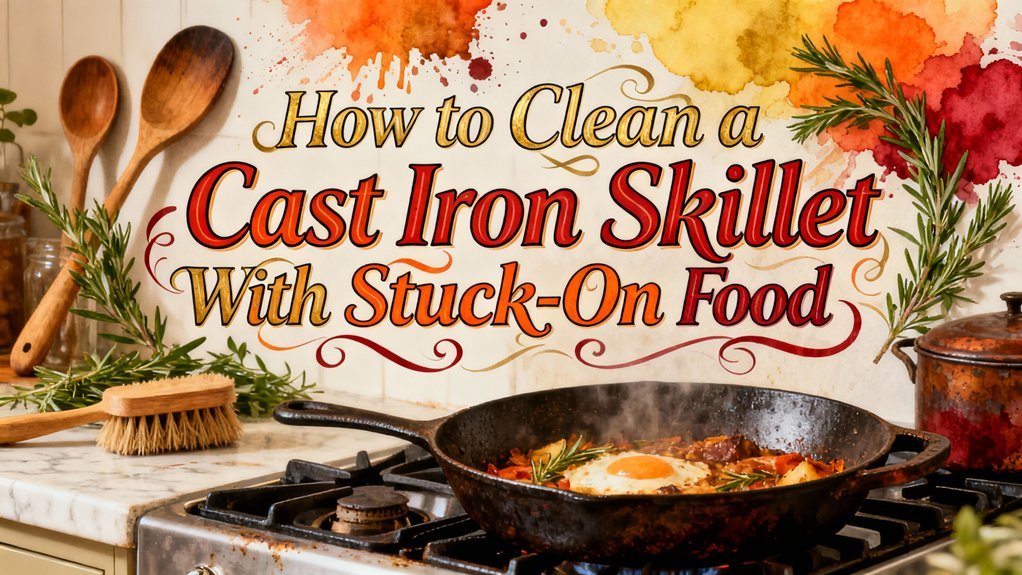
You’ll remove stuck-on food effectively by rinsing immediately with hot water, then applying the salt-scrub method—sprinkle coarse kosher salt across the pan’s bottom and scrub vigorously with a bundled cloth or paper towel. For heavier buildup, use a chainmail scrubber or brass-bristle brush while the skillet’s still warm. Deglaze stubborn bits with water or stock on a hot pan, then dry promptly and apply a thin oil layer. Understanding the complete restoration process reveals additional techniques for maintaining your skillet’s longevity.
Prep and Safety Considerations
You’ll want to address four critical areas before you begin cleaning your cast iron skillet: drying and post-clean maintenance, personal protective equipment, tool selection, and chemical safety.
Start your pre-cleaning preparation by gathering heat-resistant gloves or potholders to protect against burns from warm pans. If you’re using chemical strippers or strong cleaners, wear rubber gloves and eye protection, particularly when applying aerosolized products. Ascertain adequate ventilation—perform heavy-duty chemical treatments outdoors or in well-ventilated spaces. Dry the skillet thoroughly with a dishcloth or paper towel immediately after washing to prevent rust formation. After cleaning, apply a thin coat of fat to the pan’s surface to maintain its seasoning and protect against rust during storage.
Select appropriate safety equipment based on your cleaning method. For routine cleaning, nonmetal scrapers and stiff nylon brushes suffice. For extreme restoration requiring caustic oven cleaner, employ full PPE and work in a thoroughly ventilated area. For those with access to more advanced equipment, electrolysis tanks can remove all rust and buildup more thoroughly. The coarse texture of kosher salt also works as a gentle abrasive for removing food particles without damaging the pan’s seasoning. Consider using airtight seals on storage containers to keep your cleaning supplies organized and protected from humidity. For best results, choose oils with a high smoke-point when applying protective coats after cleaning. Regular maintenance through re-seasoning occasionally] will help maintain your skillet’s longevity and non-stick performance. Keep first-aid supplies and neutralizing materials nearby when handling caustics or high heat, confirming you’re prepared for any unexpected incidents during the cleaning process.
Basic Cleaning for Light Residue
Since most daily cast iron use leaves only light food particles and oil residue, a straightforward cleaning routine‘ll protect your seasoning while keeping the skillet hygienic. Start by rinsing immediately with hot running water to loosen debris and oils. Use water as hot as you can tolerate to help dissolve fat and soften particles.
For your cleaning techniques, apply a nylon brush or non-metal scrub sponge to remove loosened residue without stripping seasoning. Avoid steel wool, which damages well-seasoned surfaces. If needed, use a small amount of mild dish soap applied directly to your brush rather than soaking the pan. Regular maintenance with this straightforward approach is crucial in minimizing buildup and preventing excessive carbon deposits from accumulating on your skillet. Dutch oven recipes that feature hearty one-pot meals similarly benefit from proper cast iron maintenance to ensure longevity. Cast iron cookware like Dutch ovens can be used over a campfire for outdoor cooking, which requires extra attention to maintenance afterward. To prevent damage from thermal shock, avoid rinsing your skillet with cold water on hot steel. For stubborn residue, coarse salt can serve as an effective abrasive scrubbing agent without damaging your seasoning. Rinse thoroughly to remove all detergent residues, then dry promptly with a lint-free cloth and apply a thin oil layer while warm. Cast iron’s exceptional ability to retain heat makes thorough drying essential to prevent rust formation. To maintain the non-stick surface and protect the seasoning, wipe until no oil residue remains on the skillet’s surface.
Salt-Scrub Method for Stuck-On Bits
When light residue won’t budge with water alone, a salt-scrub method offers an effective alternative that maintains your skillet’s seasoning while dislodging stubborn food particles. Use coarse kosher or sea salt—never fine table salt, which clumps and reduces scrub efficiency. Sprinkle a light to moderate layer across your pan’s bottom, then bundle a paper towel or cloth and scrub vigorously until debris loosens. For tougher spots, a metal spatula can initially dislodge large flakes before salt scrubbing. The salt advantages include minimal water exposure and micro-abrasion that avoids excessive surface scratching. This scrub method is easy, cheap, and effective for removing even the most stubborn stuck-on food. After scrubbing, dump the salt and wipe your pan clean. Immediate drying with a clean paper towel safeguards against rust while maintaining your cast iron’s protective seasoning layer. The heat retention properties of cast iron make this simple maintenance routine all the more worthwhile for preserving your investment. For best results, clean your skillet while it is still warm from cooking, as this enhances the effectiveness of the salt scrub and makes food removal easier. Allowing the salt to cook for several minutes on a smoking hot skillet extracts additional impurities and further loosens debris from the pan’s surface. For extra stubborn residue, boiling water and baking soda can be used as an alternative method to safely remove stuck-on food without damaging the enamel. If rust does develop despite your maintenance efforts, vigorous scrubbing and reseasoning] can restore your skillet to full functionality. Optional rinsing followed by immediate drying safeguards against rust while maintaining your cast iron’s protective seasoning layer.
Mechanical Removal for Heavy Buildup
Once salt-scrubbing reaches its limits with particularly stubborn deposits, mechanical tools become your next line of defense for dislodging heavy buildup without compromising your skillet’s seasoning. Chainmail scrubbers excel at residue removal through vigorous circular motions with moderate pressure. Stiff nylon or brass-bristle brushes provide effective mechanical scrubbing while minimizing seasoning damage compared to steel wool. Rigid plastic or metal pan scrapers work at low angles to pry up carbonized bits without aggressive scratching. For ideal results, combine these tools with heat: reheat your pan on the stovetop or add steam to loosen stubborn food before mechanical removal. Wiping out the pan immediately after using water helps prevent residue buildup that could complicate future cleaning efforts. Unlike dishwashers which are unsuitable for cast iron due to moisture and rust concerns, these manual cleaning methods preserve your cookware’s integrity. Similar to how deglazing with liquid lifts browned bits in Dutch oven cooking, heating your cast iron can help release stuck-on deposits. This integrated approach clears stuck deposits efficiently while preserving your seasoning layer. Dry thoroughly and reapply oil immediately after cleaning.
Deglazing and Chemical Aids
How you deglaze your cast iron—and what liquid you choose—significantly impacts both cleaning effectiveness and seasoning preservation. Water remains your safest option, lifting fond without introducing acids that attack seasoning. Stock adds flavor while loosening stuck bits; wine or beer dissolves browned particles quickly but risks etching newer layers with prolonged contact.
Always deglaze with your pan still hot—this immediate sizzle helps loosen fond effectively. Simmer your deglazing liquid briefly, then scrape with a wooden spatula for mechanical removal paired with heat. A specialized cast iron scrubbing brush with high heat-tolerant bristles can also enhance the scrubbing process during deglazing.
For stubborn buildup, chemical cleaners offer targeted solutions. Coarse kosher salt acts as a mild abrasive, while mild dish soap handles routine cleaning. Commercial cast-iron pastes remove carbonized buildup with minimal abrasion. If stubborn food remains after initial cleaning, you can repeat the heating and scraping process to further loosen debris. The polymerization of oils creates a resilient non-stick layer that protects your skillet when properly maintained. Always finish by evaporating residual liquid, then wipe with oil to recoat your seasoning.
Rust Spot Treatment and Restoration
Even with meticulous cleaning and oiling, rust can still develop on your cast iron—especially in humid environments or where moisture collects around the rim, handle, and underside. Effective rust identification methods start with visual inspection for orange flaking and pitting, then tap-testing suspect areas to gauge oxidation severity.
For restoration techniques, use medium-to-fine steel wool or a scouring pad to abrade oxide until bare metal emerges. For extensive rust, employ an orbital sander with fine abrasive discs. After mechanical removal, neutralize any acid residue and immediately towel-dry your pan, then heat-dry on low stovetop heat. Vintage cast iron from antique stores often shows rust but has restoration potential despite its aged appearance. Rust develops when the protective seasoning layer is missing or damaged, leading to sticking and potential weakening of the pan over time.
Apply a thin oil layer while warm to prevent flash rust. For stubborn rust that resists mechanical removal, a vinegar bath with short soaks of around 40 minutes can effectively dissolve oxidation before you proceed with scrubbing and rinsing. Similar to how flash-freezing] prevents food from sticking together during preservation, applying oil promptly after rust removal prevents oxidation from reforming on your skillet’s surface. While cast iron is primarily valued for stovetop cooking, it can also be used for oven cooking methods to achieve even heat distribution and superior results. Regular seasoning maintenance through occasional oven seasoning] will further protect against future rust development. Store in low-humidity, well-ventilated spaces with a paper towel inside to absorb residual moisture. Allowing water to sit on cast iron for extended periods accelerates rust formation], so ensure your skillet is completely dry after every wash and use.
Re-Seasoning Your Skillet
After you’ve treated rust and thoroughly dried your skillet, you’ll want to build up a fresh seasoning layer that creates a durable, non-stick cooking surface. Understanding proper seasoning techniques guarantees peak results. Apply a thin oil layer to all surfaces—including the handle, exterior, and crevices—using a lint-free cloth. Buff away excess oil to prevent pooling. Position your skillet upside down on the center oven rack at 450-500 degrees Fahrenheit for one hour, placing foil below to catch drips. Allow natural cooling inside the closed oven for several hours. The seasoning benefits compound through repetition; complete 3-5 cycles to develop a blackened, durable finish. For optimal results, use lard, grease, or oil as these traditional fats create superior non-stick layers compared to other options. Beef tallow is particularly valued for its high smoke point and natural composition, making it an excellent choice for building a protective seasoning layer. Oils with high smoke points like vegetable oil, canola oil, grapeseed oil, and refined coconut oil are also excellent alternatives that withstand the high temperatures needed for proper seasoning without breaking down. When oil is heated to its smoke point, it bonds chemically with the cast iron to form a durable protective layer. Storing your skillet properly with separators to allow airflow helps preserve the seasoning between uses. Each subsequent cooking use further strengthens your skillet’s protective layer.
Storage and Long-Term Maintenance
Because proper storage directly impacts your skillet’s longevity and performance, you’ll want to choose a method that balances accessibility with protection. Vertical solutions like tiered organizers work well for multiple pieces, fitting conveniently on countertops or in cabinets. Wall-mounted displays on sturdy hooks near your stove offer easy access while showcasing your collection. Commercial grid walls provide flexible hook positioning that allows you to reconfigure your storage layout as your collection evolves.
When you store skillets, proper stacking prevents damage. Layer newspaper or cork spacers between pans to eliminate scratches. This protective barrier maintains your skillet’s seasoning and appearance over time. Magnetic hangers provide an excellent alternative for displaying a few skillets in limited space while keeping them easily accessible.
For ideal long-term maintenance, store your skillet in a dry location away from moisture. Humidity causes rust development that compromises your cookware’s integrity. Avoid storing food in your cast iron skillet, as this damages the seasoning layer and reduces its effectiveness. Whether you choose stovetop storage for daily-use pans or dedicated vertical solutions for your full collection, prioritize dry conditions to preserve your investment.