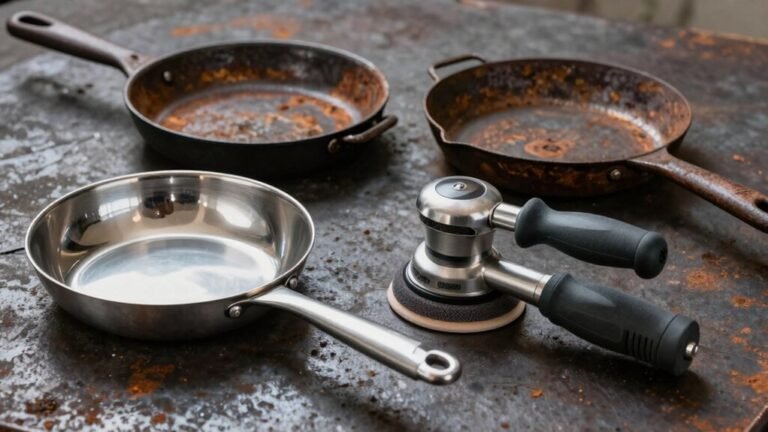
You don’t need a Dutch oven for sourdough, but you’ll need to replicate its two critical functions: even heat distribution and steam retention during the first 15–20 minutes. Alternatives like cast iron skillets, covered baking pans, preheated baking stones with inverted metal bowls, or roaster pans can trap steam effectively. While Dutch ovens provide consistent results through their heavy construction and tight-fitting lids, understanding the underlying thermal dynamics reveals several viable approaches to achieving professional-quality crusts.
Why Heat Distribution Matters for Sourdough
When you’re baking sourdough, even heat distribution determines whether you’ll achieve a beautifully risen loaf with uniform crust development or end up with dense, unevenly browned bread. Inconsistent oven temperatures impede ideal oven spring, causing localized hot spots that over-brown your crust before full expansion occurs. Superior heat retention and temperature management prevent these complications.
You’ll notice that uneven heating creates dense texture and underproved sections throughout your loaf. The dough’s surface needs to remain pliable during the first twenty minutes of baking—a window that depends entirely on consistent heat. When temperatures spike unevenly above 400°F, you risk hindering rise rather than enhancing it. Just as cast iron requires proper preheating to avoid uneven cooking, your sourdough needs consistent oven temperatures from the start. Accurate temperature control ensures your baking environment maintains the precise heat levels needed for optimal results. Dutch oven size impacts the radiant heat your loaf receives during this critical phase. Proper heat distribution allows your dough to expand fully before the crust sets, delivering the professional-quality results you’re pursuing. Using a Dutch Oven or Baking Stone creates a self-contained environment that traps steam, maintaining steady temperatures and preserving moisture throughout the critical initial baking phase. A dutch oven’s heavy construction and tight-fitting lid work together to create the optimal conditions for sourdough by ensuring uniform heat exposure and moisture control. Like sous vide’s reliance on consistent heat retention, sourdough baking depends on your oven’s ability to maintain unwavering temperatures for optimal results.
How Steam Affects Crust Development
While heat distribution sets the foundation for proper oven spring, steam is what allows you to actually achieve it. During the first 15-20 minutes, steam retention keeps your dough’s surface moist and flexible, enabling extended expansion before the crust hardens. This delayed crust formation lets CO2 escape and your gluten network trap gas for maximum volume increase.
Steam simultaneously promotes starch gelatinization, causing granules to swell and form the glossy, brittle shell characteristic of artisan bread. Without adequate steam, your exterior hardens prematurely, restricting rise and producing a dense loaf with poor crust texture. The Maillard reaction facilitated by steam also enhances your crust’s color and flavor during baking. Increasing steam duration at the beginning of baking enhances crust thinness by prolonging the moisture retention phase. Most home bakers find that the steam-trapping method produces bakery-style results that would otherwise be difficult to achieve without professional equipment. Similar to how cast iron distributes heat evenly in other baking applications, a Dutch oven’s construction ensures consistent results.
A Dutch oven excels at steam retention by trapping your loaf’s own moisture, creating an ideal microclimate. The tight-fitting lid works in conjunction with the thick cast iron to maintain moisture throughout the bake. When selecting a Dutch oven for bread baking, consider factors like size, material, and whether to choose enameled or bare cast iron options based on your specific baking needs. The enameled cast iron or traditional cast iron construction of a Dutch oven provides superior heat retention and distribution throughout the baking process. After 15-20 minutes, you’ll vent the lid to allow crust hardening while preserving the crispy, complex texture you’ve developed.
Alternative Baking Methods That Work
Though a Dutch oven remains the gold standard for steam retention, you can still achieve excellent sourdough results with alternative methods that replicate its microclimate. Cast Iron skillets on bottom racks generate reliable steam when you pour boiling water into them. Baking Dish towel methods work similarly, saturating rolled towels with hot water for consistent steam release. Aluminum Foil pans offer a simpler approach—position them on lower racks and add hot water after protecting your oven glass. Covered Pan or Dish Baking using CorningWare or cast iron with lids traps steam effectively for the critical initial 20 minutes. A kitchen scale helps achieve accurate ingredient weight measurements for consistent dough hydration across all alternative baking methods. Even Crockpot Baking produces edible loaves, though results differ from traditional oven methods. Research into Dutch oven alternatives has revealed that roaster pans provide lightweight and cost-effective options for home bakers. Each technique successfully creates the humid environment your sourdough requires for peak crust development.
Equipment Considerations and Costs
Successfully baking sourdough with a Dutch oven requires you to evaluate whether the upfront investment and ongoing operational costs align with your baking goals. A quality enameled Dutch oven typically costs $80–$150, while bare cast iron runs considerably less. Equipment lifespan varies greatly: well-maintained cast iron lasts decades, whereas cheaper enameled versions may chip sooner, affecting cost-per-year calculations.
Beyond purchase price, you’ll encounter recurring operational costs. Preheating for 30–60 minutes increases energy consumption per bake. Parchment liners add $0.10–$0.50 per loaf. Maintenance supplies for seasoning or cleaning cost roughly $5–15 annually. A 4-5 quart Dutch oven is ideal for round loaves and provides the optimal size for home bakers. If you’re baking smaller loaves or cooking for fewer people, 3-quart Dutch ovens can work effectively with proportionally reduced dough quantities. The Dutch oven’s excellent heat retention ensures even baking results and proper steam retention throughout the baking process. The enamel coating quality and overall durability of your Dutch oven directly impact how well it performs over multiple years of regular use. Like precision cooking techniques that demand exact temperature control, sourdough baking benefits from the Dutch oven’s ability to maintain consistent heat throughout the baking cycle. Just as flash-freezing] preserves food quality by preventing degradation during storage, the Dutch oven’s heat retention preserves your bread’s texture and crust during the critical baking stages. Le Creuset Dutch ovens can withstand high temperatures needed for baking, ranging from 450–500°F, which ensures proper crust development.
Pot versatility justifies the investment—your Dutch oven functions for stovetop cooking, braising, and roasting, distributing costs across multiple culinary applications rather than sourdough baking alone.
Achieving Professional Results Without Specialized Tools
If you don’t own a Dutch oven, you can still achieve professional sourdough results by replicating the pot’s core function: trapping steam during the critical early bake stages. Start by preheating a baking stone for 45–60 minutes to build thermal mass. Reduce dough hydration slightly (2–5 percentage points) to improve handling and prevent collapse without steam containment. Employ tighter shaping techniques and extended bulk fermentation to develop structural strength that compensates for less steam-assisted oven spring. During baking techniques, introduce steam via a preheated water pan at placement, or invert a metal bowl over your loaf for the first 15 minutes. For optimal results, maintain your ambient temperature between 18C and 20C during fermentation to ensure even dough development and proper rise. Many bakers achieve excellent results by preheating with the lid off to reduce the risk of burns from steam while still developing quality crust. Remember that sourdough starter acts as a natural leavening agent without requiring commercial yeast, which means your fermentation timing becomes even more critical when working without a Dutch oven. Keep in mind that infrared thermometers may provide inaccurate readings on shiny baking equipment, so use contact thermometers for precise temperature monitoring if relying on metal surfaces. These adjustments—combined with strategic temperature management and cold retardation—deliver excellent crust development and bloom without specialized equipment.
The Science Behind Fermentation and Flavor
While mastering equipment and technique builds the foundation for excellent sourdough, what truly distinguishes artisanal bread is the microbial alchemy happening within your dough. Your fermentation dynamics depend on wild yeast and lactic acid bacteria (LAB) working symbiotically. Wild yeast breaks down flour carbohydrates into glucose, which ferments into ethanol and CO2—creating rise and structure. Simultaneously, LAB performs lactic acid fermentation, lowering your dough’s pH from 6.5 to 3.5 while producing the tangy flavor profile you’re seeking. Acetic acid bacteria further enhance sourness by oxidizing ethanol into acetic acid. This flavor complexity emerges from cold proofing, which activates heterofermentative bacteria, releasing proteolytic enzymes and free amino acids. The primary LAB species responsible for this transformation include Lactobacillus sanfranciscensis, which are particularly effective at thriving in the acidic environment created during extended fermentation. Regular feeding of your starter maintains microbial diversity, ensuring that the hundreds of bacterial species and strains present continue to add complexity to your final taste. The interplay between these microorganisms creates nuanced tastes impossible with commercial yeast alone.
Nutritional Benefits of Long-Fermented Bread
Beyond flavor complexity, the microbial activity you’ve cultivated through extended fermentation fundamentally transforms your bread’s nutritional profile. You’re reducing phytic acid levels that otherwise bind minerals like iron, zinc, and magnesium—a process particularly pronounced in whole-grain and rye formulations. This enhanced mineral absorption makes your sourdough remarkably more nutrient-dense than non-fermented equivalents. Naturally fermented bread employs naturally-occurring yeasts that contribute to these mineral bioavailability improvements.
Your fermentation parameters also modify carbohydrate digestibility. Extended fermentation partially degrades starch and acidifies the dough, slowing gastric emptying and producing lower postprandial glucose and insulin responses compared with conventional bread. Studies demonstrate measurable glycemic benefits, particularly for individuals with impaired glucose tolerance. The wild yeast and bacteria present in your starter continue working throughout the fermentation period to further break down complex compounds. Like the heat-driven process in vacuum sealing, extended fermentation also reduces harmful microorganisms that could compromise your bread’s safety and shelf stability.
However, benefits vary considerably based on starter microbiota composition, fermentation duration, and flour type. A tight-fitting lid can help maintain optimal moisture levels during your fermentation process, similar to how Dutch oven lids create ideal conditions for baking. The superior heat retention and distribution of quality Dutch ovens makes them particularly effective for achieving consistent baking results. The self-basting lid of an oval Dutch oven traps steam during the baking process, resulting in a moist interior and crisp crust that enhances the final bread quality. Lodge Dutch ovens are available in multiple size options suitable for different bread batches and group sizes. Systematic reviews emphasize that standardized comparisons remain necessary before generalizing nutritional claims across all long-fermented breads.
Practical Tips for Your Baking Setup
Now that you’ve mastered fermentation science, your success depends equally on having the right tools at hand. Your baking environment begins with precise ingredient preparation—a digital scale guarantees accurate flour and water measurements, eliminating cup-to-spoon variability that compromises consistency. Invest in a 4-quart clear-sided Cambro or dough proofing bowl to monitor bulk fermentation’s 50% volume rise accurately. For shaping and handling, keep a bench scraper and bowl scraper accessible. Control your baking environment’s temperature with a Brod & Taylor Proofer if you live in cold climates. Organize your workspace with parchment paper, long silicone gloves, and a bread lame nearby. To preserve baked loaves longer, consider using vacuum sealer bags for storage after your bread has cooled completely. The enameled cast iron construction of a Dutch oven provides excellent heat retention that maintains consistent baking temperatures throughout the baking process. A Dutch oven mimics steam environment of commercial ovens, creating the ideal baking conditions for a properly crusted loaf. If you don’t have a Dutch oven available, you can achieve similar results by baking on a preheated stone or using alternative steaming methods with common kitchen equipment. This systematic setup transforms fermentation knowledge into reproducible, exceptional loaves.