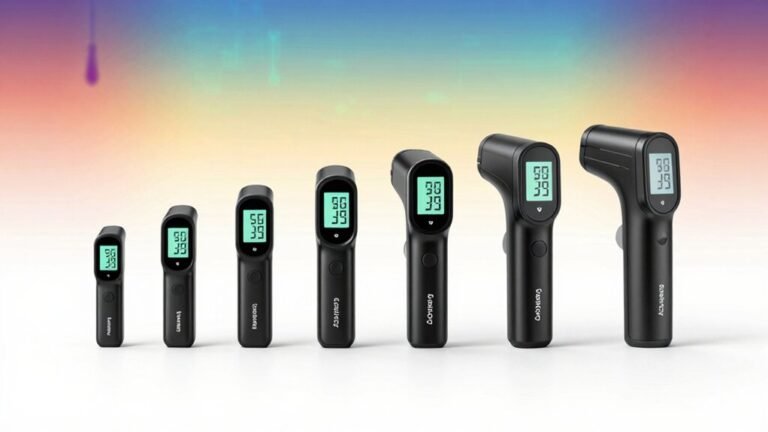
You can’t rely on infrared thermometers alone for cooking safety because they measure only surface temperature, not internal heat that kills harmful bacteria. Your readings get skewed by emissivity, reflective surfaces, and environmental factors like steam. Distance-to-spot ratio and proper positioning matter greatly. While they’re useful for quick surface checks, you’ll need probe thermometers to verify internal temperatures and guarantee food safety compliance. Understanding their distinct roles reveals why combining both methods delivers reliable results.
Understanding Surface Temperature Measurement
If you’re relying on an infrared thermometer in the kitchen, you’ll want to understand what it’s actually measuring. Your IR thermometer detects thermal radiation emitted from object surfaces only—it doesn’t penetrate below the surface. This fundamental measurement limitation means you’re getting surface temperature data exclusively. Temperature variations occur depending on distance; closer proximity narrows your spot size for precision, while farther measurements expand the spot and risk including surrounding ambient heat. Your laser pointer aids targeting but doesn’t measure temperature itself. Accuracy also depends on optics diameter and manufacturer specifications. The emissivity rating of your target surface significantly influences whether the thermometer correctly interprets the thermal radiation being emitted. Environmental factors such as ambient temperature and direct sunlight can influence measurement accuracy, similar to challenges faced in clinical settings. To achieve reliable results, allow your thermometer to acclimate to its environment for 10-30 minutes before taking measurements. When selecting an infrared thermometer for kitchen use, consider the distance-to-spot ratio to ensure precise targeting of your cooking surface. Infrared thermometers excel at measuring surface temperatures like oil during frying or meat on a grill, but they cannot determine internal food temperatures where a probe thermometer is necessary. Their rapid measurement capability makes them valuable for process monitoring in food service applications. Significantly, you cannot measure through steam or vapor, as these obstruct thermal radiation detection and produce inaccurate readings. Regular calibration and validation are essential to maintain your thermometer’s accuracy over time. Understanding these constraints guarantees you’ll interpret results appropriately.
The Critical Difference Between Surface and Internal Temperatures
Because infrared thermometers measure only surface radiation, they can’t directly tell you what’s happening inside your food—and that distinction matters critically for food safety. You’re dealing with surface gradients: thicker, high-moisture items like whole chickens develop substantial temperature disparities between their exterior and core. These surface-to-internal gaps widen unpredictably depending on food geometry, composition, and heat transfer patterns. Bone-in or stuffed products complicate matters further, since surface readings poorly represent internal zones near cavities or bones. Thin items like burgers show smaller disparities, making surface temperatures more representative. Infrared thermometers can also produce inaccurate readings on shiny surfaces due to reflectivity issues that interfere with proper temperature detection. The distance-to-spot ratio determines how accurately your device captures the target surface area from your working distance. To achieve accurate readings, the thermometer must be held perpendicular to the target surface and positioned at the proper distance for your specific device model. Infrared thermometers detect infrared radiation emitted from surfaces rather than measuring the air or internal heat directly. The contactless measurement approach of infrared thermometers works well for appliances but cannot replace probe verification for food safety. For the most reliable food safety verification, oven-safe probe thermometers are designed to remain in the meat throughout the cooking process and provide continuous temperature monitoring. Without validated, product-specific correction factors and probe verification, you risk relying on surface readings that systematically underestimate or misrepresent actual internal temperatures where pathogens die.
Why Calibration Matters for Reliability
Recognizing surface-temperature limitations puts you at a crossroads: you can either accept unreliable readings or implement calibration protocols that restore accuracy and traceability. You’ll find that calibration techniques directly address systematic errors inherent to infrared measurement. Using ice-water (32°F) or boiling-water (212°F) references establishes baseline temperature accuracy without expensive equipment. For demanding applications, you’d employ professional schemes utilizing precision calibrators like Fluke instruments, selecting calibration points based on your usage range. You’ll align perpendicular within 5 degrees to guarantee ideal performance. Maintaining proper measuring distance alignment and centering the thermometer are critical factors that eliminate errors from improper positioning. Understanding your thermometer’s distance-to-spot ratio ensures the measurement area stays completely on the intended surface rather than picking up surrounding temperatures. These devices detect thermal radiation emitted from surfaces, making accurate positioning essential for reliable readings. Just as vacuum sealing preserves food quality by controlling environmental factors, proper thermometer calibration maintains measurement integrity under varying outdoor cooking conditions, similar to how lids retain moisture during stovetop and oven cooking. Cast iron skillets require precise temperature management, with preheating to around 375°F ensuring even heat distribution for consistent cooking results. Periodic validation using laboratory-calibrated master thermometers in comparator cups confirms reliability. Regular recalibration at recommended intervals prevents performance degradation and maintains traceability over time. You’re not simply “checking” your thermometer—you’re documenting traceability and preventing costly cooking failures. Calibration transforms your infrared thermometer from an unreliable device into a dependable measurement instrument.
How Emissivity Affects Your Readings
While calibration establishes your thermometer’s baseline accuracy, you’ll quickly reveal that emissivity—the surface’s capacity to emit infrared energy—fundamentally determines whether you’re reading actual cooking temperatures or misleading values. Emissivity variations dramatically impact results: organic materials like food hover near 0.95, while reflective surfaces such as polished stainless steel drop to 0.1 or lower. Your thermometer’s preset 0.95 setting works reliably for most foods but fails catastrophically on shiny cookware, potentially showing 100°F instead of 212°F. You can compensate by adjusting emissivity settings to match specific materials or applying non-reflective tape. Infrared thermometers are vulnerable to visual obstructions that can interfere with accurate surface readings during the cooking process. As the distance-to-spot size ratio approaches 6:1, your measurements become increasingly precise when the distance to the object does not exceed its size. Understanding these distinctions transforms your infrared thermometer from an unreliable gadget into a precision instrument, ensuring you accurately assess doneness across varied cooking surfaces.
Common Myths About Infrared Thermometers
Despite their growing popularity in home kitchens, infrared thermometers are shrouded in misconceptions that can undermine your cooking accuracy. One prevalent laser misconception assumes the red dot measures temperature—it doesn’t. The laser merely guides your targeting; the infrared sensor detects heat. Another myth claims these devices measure internal food temperature accurately. They don’t. Infrared thermometers read only surface temperatures, making them unsuitable for large meats requiring core temperature verification. You’ll need a probe thermometer for that task. Understanding infrared limitations proves critical. The devices fail on shiny surfaces, struggle beyond 3-4 feet, and yield inaccurate readings on boiling water due to vapor interference. Environmental factors compound these challenges, requiring proper calibration and conditioning before use to avoid misleading measurements. Similar to how gentle cleaning methods preserve cookware integrity, careful handling and proper preparation of infrared thermometers maintain their reliability. For precise cooking applications like candy-making, infrared thermometers are inaccurate due to their inability to handle reflective surfaces and variable heat emission from different materials.
Best Practices for Accurate Temperature Monitoring
To maximize accuracy with infrared thermometers, you’ll need to move beyond the device’s basic operation and implement systematic measurement practices. Start by setting emissivity to ~0.95 for food measurements, then clean your target surface to eliminate condensation or debris that distorts readings. Adopt effective monitoring techniques by positioning yourself within the device’s distance-to-spot ratio and keeping the sensor perpendicular to the surface. For shiny cookware, apply matte tape or thermal paint to eliminate reflectivity errors. Just as with fever detection, environmental factors can significantly impact your infrared thermometer’s readings in the kitchen. Validate best measuring practices by developing documented surface-to-internal temperature correlations for specific foods, especially thick items requiring probe thermometers for doneness verification. These correlations prove particularly useful when cooking popular proteins like steak, chicken, and salmon, ensuring consistent results across your cooking sessions. For comprehensive temperature monitoring during cooking, consider using smart thermometers with ambient sensors to track both internal meat temperature and the cooking environment simultaneously. Beyond traditional meat cooking, wireless thermometers designed for oven use can expand your temperature monitoring capabilities in the kitchen. Standardize your preparation steps in recipes or standard operating procedures to guarantee repeatable, reliable results across cooking sessions.
When to Use Probe Thermometers Instead
Systematic surface monitoring through infrared thermometers reaches its practical limits when you’re cooking thick or dense foods, where internal temperatures don’t reliably correlate with external readings. You’ll need probe thermometer advantages when preparing whole chickens, roasts, or similar cuts requiring verification of minimum safe internal temperatures at the thickest points.
Probe thermometers deliver readings within 1-2 degrees, eliminating guesswork and ensuring compliance with food safety standards. Digital probes handle temperatures up to 212°F internally and 572°F ambient, making them ideal for grilling, baking, and smoking applications. Smart probe thermometers with wireless connectivity features can transmit real-time temperature data to your smartphone, allowing you to monitor multiple cuts of meat simultaneously without staying near the cooking surface. The tight-fitting lid of specialized cookware like Dutch ovens helps maintain consistent temperatures during the cooking process, which complements probe thermometer readings for optimal results. Like cast iron cookware that requires proper seasoning to maintain its cooking surface, probe thermometers need regular calibration to ensure accurate readings. Proper probe placement at the thickest point of the meat ensures you’re capturing the most accurate internal temperature reading for your food safety verification. When comparing thermometer options, it’s important to evaluate models across different price points to find the right balance between features and budget for your cooking needs.
However, probe thermometer limitations warrant consideration. Bimetallic probes require 15 seconds for steady readings in dense foods. For optimal accuracy, probe thermometers must be precise within ±1°C to maintain compliance with food safety standards. Despite these minor constraints, probe thermometers provide the invasive internal validation that infrared simply cannot match for safety-critical cooking applications.
Operator Technique and Environmental Factors
How you hold and aim your infrared thermometer matters as much as the device itself—proper technique directly determines whether you’re capturing genuine surface temperature or averaging multiple heat sources simultaneously. Your operator alignment and distance ratio determine spot size; larger ratios let you measure from farther away, but misalignment captures surrounding cooler or warmer surfaces instead of your target. Always aim at matte surface finish, never reflective stainless steel or glossy fats that produce falsely low readings. Environmental interference—steam, vapor, and nearby hot masses—obscures IR signals and biases results downward. Stabilize your aim before reading, avoid measuring during strong convection, and account for ambient temperature extremes that degrade sensor calibration. These variables compound measurement error faster than device limitations alone.
Validating Your Infrared Thermometer for Specific Foods
Even perfect operator technique won’t compensate for systematic bias in your specific cooking application—you’ll need to validate your infrared thermometer against known standards before relying on it for food safety decisions. Compare your IR device’s readings directly to a calibrated reference probe across your target temperature range, recording mean differences and 95% confidence intervals for each food type. Document measurement geometry (distance, angle, spot size) and emissivity values you use, since these parameters fundamentally affect accuracy. Establish acceptance criteria—typically ±1–2°C of reference—and flag foods failing validation. Repeat validation monthly or after device repairs. Remember that emissivity affects infrared measurement accuracy, so verify your device is set to the correct emissivity value for each food surface before taking readings. This systematic approach reveals whether your thermometer performs reliably for specific surfaces like crusts, sauces, or raw meat before deployment. For glazed foods such as those with sweet orange glaze, validation becomes especially important since the glossy coating can significantly alter surface emissivity and affect temperature readings.