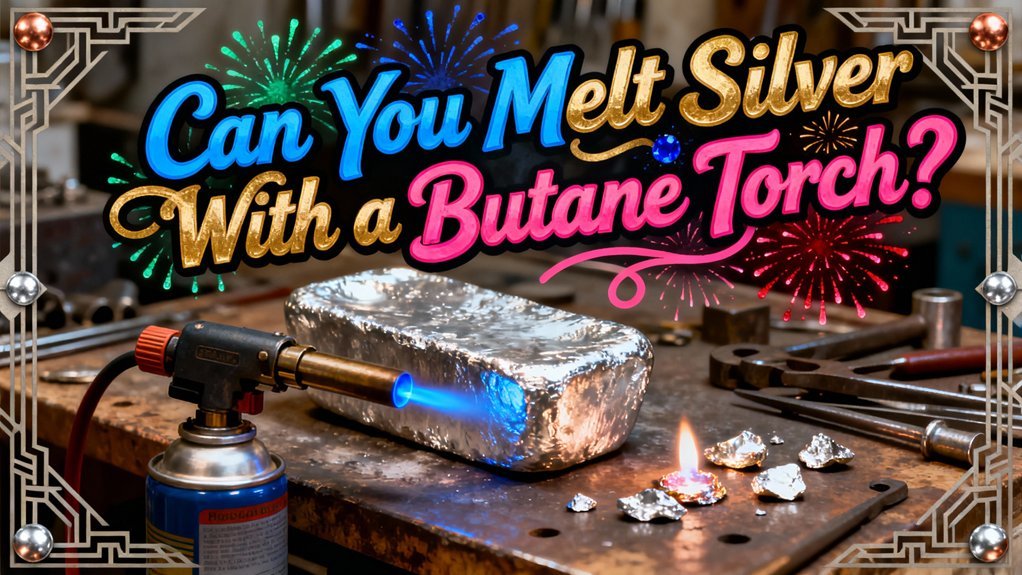
You can melt silver with a butane torch if you’re working with small pieces under ten grams. Your torch reaches approximately 1400°C in its blue flame section, exceeding silver’s 961.8°C melting point. However, silver’s high thermal conductivity rapidly disperses heat, so you’ll need proper insulation, ideal positioning, and sustained flame contact. Success hinges on minimizing heat loss through firebrick supports and charcoal blocks. Uncover how workpiece size, crucible selection, and setup optimization dramatically influence your results.
Melting Point of Silver and Butane Torch Temperature
Since pure silver melts at 961.8°C (1763°F), you’ll need to understand whether a butane torch can actually reach and sustain this temperature. Standard butane torches produce maximum temperatures around 1300°C, with the blue flame section reaching approximately 1400°C. This exceeds silver’s melting point, suggesting feasibility.
However, torch efficiency matters greatly. Your handheld torch’s practical output typically ranges from 1200–1400°C, though this drops considerably with air dilution. You’re working with concentrated heat zones rather than uniform temperatures. Sustained heat application is necessary because the complex crystal structure of silver requires consistent thermal energy to fully disrupt its atomic arrangement. Proper flame control allows you to maintain the concentrated heat needed for successful melting. To improve efficiency and reduce heat loss, specialized heat-resistant containers or crucibles are recommended for better results, similar to how steam retention must be carefully managed to achieve desired bread baking outcomes. Using organized portioning methods can help you prepare multiple silver pieces systematically for melting projects.
Silver alloys simplify this process greatly. Sterling silver melts at 893°C, while Britannia silver requires 940°C—both substantially below your torch’s capability. Pure silver demands precise sustained heat above 961.8°C, making alloys more forgiving for practical melting applications. The high melting point of pure silver makes it less suitable for amateur torch-based melting compared to its alloyed variants.
How Heat Transfer and Heat Loss Affect Melting
While a butane torch’s flame temperature exceeds silver’s melting point, reaching that temperature at your workpiece is a different matter entirely. You’re fighting three simultaneous heat loss mechanisms: conduction, convection, and radiation. Silver’s high thermal conductivity (429 W/m·K) rapidly disperses heat away from your flame’s focal point into supports and the bulk material. Metal fixtures act as heat sinks, draining energy faster than you can supply it. Simultaneously, convective losses accelerate with air movement, while radiative losses intensify as temperatures climb. To succeed, you’ll minimize conduction by using insulating supports like firebrick, shield against drafts, and maximize heat flux density through precise torch positioning. Much like achieving an even crust requires ensuring the pan is hot when blackening fish, consistent heat application is essential for melting silver effectively. Strategic preheating of supports further reduces the energy gap to melting, similar to how preheating cookware improves overall heat distribution and cooking performance. Just as rigorous testing methodology helps identify the best tools for specific applications, understanding your torch’s performance characteristics enables better heat management. For optimal results with small quantities of silver, high-quality butane ensures consistent flame output and better heat management throughout your process. Developing a personal feel for when sufficient heat has accumulated is critical, as heat loss rates can vary significantly based on your specific setup and environmental conditions.
The Role of Workpiece Size in Melting Success
The mass of your workpiece fundamentally determines whether you’ll succeed or fail with a butane torch. Small pieces—foils, thin wires, and granules under 10 grams—heat rapidly due to low thermal mass, achieving melting efficiency that handheld torches can reliably deliver. Conversely, bulk bars exceeding 100 grams require sustained high-temperature contact that butane flames cannot maintain, resulting in failure.
Your mass influence on melting scales inversely with cross-sectional area. Thin sheet reaches liquefaction faster than equivalent weight in compact form because concentrated heat penetrates efficiently. Medium castings (1–100 grams) occupy a practical threshold where torch success depends heavily on geometry, crucible selection, and heating technique. Selecting the proper furnace size based on your production volume ensures you avoid wasted heat and optimize efficiency for your workpieces. Beyond this range, induction or propane stations become necessary to overcome thermal losses and achieve consistent melt. The 961.8°C melting point of pure silver establishes the baseline temperature that your butane torch must sustain to successfully liquefy the metal, making equipment selection critical for workpieces near the upper mass limits. Like glass blowing, oxygen-fuel combinations provide superior thermal performance compared to butane alone, enabling more reliable melting of larger silver workpieces when butane torches prove insufficient.
Optimizing Your Setup With Proper Support Materials
How you position your silver and what materials surround it will determine whether your butane torch reaches melting temperature or merely heats the workpiece to a plateau. Your support materials directly control heat efficiency. Dense firebricks provide thermal mass that maintains high local temperatures while reducing heat loss to surroundings. Charcoal blocks reflect radiant heat back into the metal, shortening torch dwell time and raising workpiece temperature. Positioning your silver in a shallow cavity or recess concentrates flame exposure and minimizes convective losses. Preheat these support materials before adding metal—this prevents your silver from acting as a heat sink that wastes fuel. Consider wrapping your melting setup with high-temperature resistant mineral wool to create a furnace-like effect that enhances heat retention. As demonstrated in melting experiments, butane torches require proper thermal management to avoid plateau temperatures where the metal stops heating despite continued flame application. Since butane torches reach maximum temperatures around 2,450°F to 2,500°F, achieving the right support material configuration becomes even more critical for success. Thin-walled graphite crucibles heat faster than ceramic alternatives, further optimizing your setup’s thermal performance with limited butane output.
Real-World Results From Jewelry Bench Practice
When you step up to your jeweler’s bench with a butane torch and small silver charge, you’ll find that success hinges on three interconnected variables: torch capacity, crucible selection, and heat distribution technique. Practitioners consistently report reliable melting of sub-5–10 g charges using larger handheld butane units, particularly when employing graphite or silica crucibles positioned on insulated firebrick. Your results improve markedly when you apply flux, maintain a slightly reducing flame, and rotate the torch to distribute heat evenly. However, melting alloys—especially sterling or casting-grade material—often demands longer cycles than pure silver. For enhanced consistency, many jewelers invest in proper crucibles such as 3×4 cylinders to ensure adequate heat retention during the melting process. Similar to how extending shelf life requires proper storage techniques, achieving reliable melting results depends on maintaining optimal crucible conditions throughout your work. Larger charges typically exceed butane’s practical limits, forcing you toward oxy-fuel systems for consistent, rapid results across professional jewelry techniques. Unlike acetylene torches, which can handle melting for any jewelry project size with greater efficiency, butane torches remain most practical for smaller charges under controlled bench conditions.
Understanding Torch Design and Fuel Differences
Your success at the jeweler’s bench depends not just on technique, but on which torch you’re wielding and what fuel powers it. Butane torches excel for small jewelry pieces, while conventional DIY store models handle larger silver debris. The Benzomatic TS4000’s upright design and stays-on button enhance torch ergonomics and fuel efficiency compared to forward-tipping alternatives that waste fuel as canisters empty. Flex-head designs grant precise flame control for even heating. Consider propane torches as superior alternatives—they retain heat better than butane. Butane performs most efficiently when held upright; tipping forward causes fuel escape and efficiency loss. Single-canister designs eliminate refilling interruptions during critical melting phases, maintaining consistent temperature without compromising your work. Like one-pan cooking methods, the key to efficient torch work lies in adaptability to your available equipment and maintaining consistent technique throughout the process. A blue flame indicates the torch has reached approximately 1200 °C, which exceeds the temperature needed for melting silver.
Practical Size Limits and Realistic Expectations
Before you commit to melting silver with a butane torch, you’ll need to understand what these tools can and can’t realistically accomplish. Butane limitations restrict you to small quantities—typically a few grams maximum with handheld models, or up to a couple ounces with larger butane torches paired with heat bricks. Your melting efficiency drops considerably beyond these thresholds because butane’s 2450°F maximum temperature and limited heat output can’t sustain the sustained thermal energy larger projects demand. You’ll find butane torches excel at delicate work: annealing chain links, soldering small filigree pieces, and handling jewelry components. The self-igniting mechanism on quality butane torches makes them convenient for repeated use without requiring external ignition sources, though using premium, highly refined butane helps prevent clogging and ensures optimal function. Like how a self-contained steam chamber improves baking consistency, a quality torch’s integrated ignition system enhances reliability for precision metalwork. Unlike dabbing applications where precise temperature control preserves delicate compounds, metalworking often demands sustained heat that butane struggles to provide. For more substantial metalworking tasks, propane or acetylene systems deliver the higher flame temperatures and sustained heat output necessary for reliable results. Attempting silver casting or heavy gauge metalwork will frustrate you quickly. Proper storage conditions similar to keeping sealed packages in cool, dark places can help maintain your torch fuel’s performance over time. When selecting a butane torch for your specific soldering needs, consider factors like flame control capabilities and tip configuration that directly impact your project’s success. Accept these constraints upfront, and you’ll choose the appropriate tool for your actual project scope rather than investing in equipment that underperforms your needs.
Choosing the Right Crucible and Flux for Melting
Crucible selection fundamentally determines whether you’ll successfully melt silver or waste time fighting equipment limitations. For torch melting, clay-graphite crucibles offer balanced thermal conductivity and accessibility, though silicon carbide provides superior durability for repeated use. Graphite remains chemically inert with silver, enabling fast melt cycles without contamination risks. Fused silica delivers highest purity but demands careful thermal shock management. Silicon carbide crucibles can withstand over 150 melts with proper care, making them a cost-effective choice for frequent users despite higher initial investment.
Size matters critically—your crucible capacity must exceed your charge volume by 20–30% to accommodate flux and prevent overflow. Thicker walls increase thermal mass, slowing heating; thinner walls heat faster with butane torches. Just as proper maintenance of specialized equipment extends its lifespan, thorough seasoning the crucible after use prevents cracking from residual metals and avoids damage during handling with appropriate tongs. Proper maintenance requires thorough cleaning after use to prevent cracking from residual metals and avoid damage during handling with appropriate tongs. Implementing safety mechanisms during the cooling process protects both you and your equipment from thermal hazards.
Flux types serve essential functions: borax-based formulations remove oxides effectively, while specialized silver fluxes minimize oxidation during heating. Using the correct fuel type for your torch ensures stable combustion and prevents equipment damage, just as fuel-torch compatibility is critical for safe operation. Butane torch lighters offer adjustable flame control that allows you to fine-tune heating intensity for optimal silver melting results. Select crucible materials and flux types that complement your specific torch power and production scale.
Safety Considerations and Quality Control During the Process
Since melting silver with a butane torch introduces multiple hazard categories—thermal burns, fire risks, toxic fumes, and equipment failures—you’ll need to establish thorough safety protocols before igniting the flame. Your personal protective equipment must include impact-rated eye protection, heat-resistant gloves, and flame-resistant clothing with closed-toe footwear. Workspace organization demands a non-combustible surface, minimum one-meter clearance from flammable materials, and an ABC fire extinguisher within arm’s reach. Guarantee adequate ventilation through local exhaust or open windows to disperse flux fumes. Before heating, verify torch functionality and test fuel connections using the soap-bubble method. Use refined butane such as Puretane or Whip-it! to prevent clogs and ensure consistent performance during the melting process. Ensure the torch is fully cooled before refueling to prevent accidents and maintain equipment integrity. After refueling, allow the fuel and components to stabilize for several minutes before using the torch to ensure safe and reliable operation. Monitor flame positioning continuously to prevent localized warping, keeping your tools organized based on your dominant hand to reduce accidental contact with the heat source. Just as oxygen removal techniques extend the shelf life of stored materials by preventing oxidation and degradation, proper ventilation during silver melting removes harmful fumes that could compromise both your health and the quality of your work. Unlike glass which requires very high heat close to or above 1,400°C, silver has a lower melting point of 961°C, making a butane torch more viable for this application. Selecting the right soldering tip based on your specific silver melting task will improve heat transfer efficiency and overall results. Establish an emergency protocol with a secondary person notified of your operation.