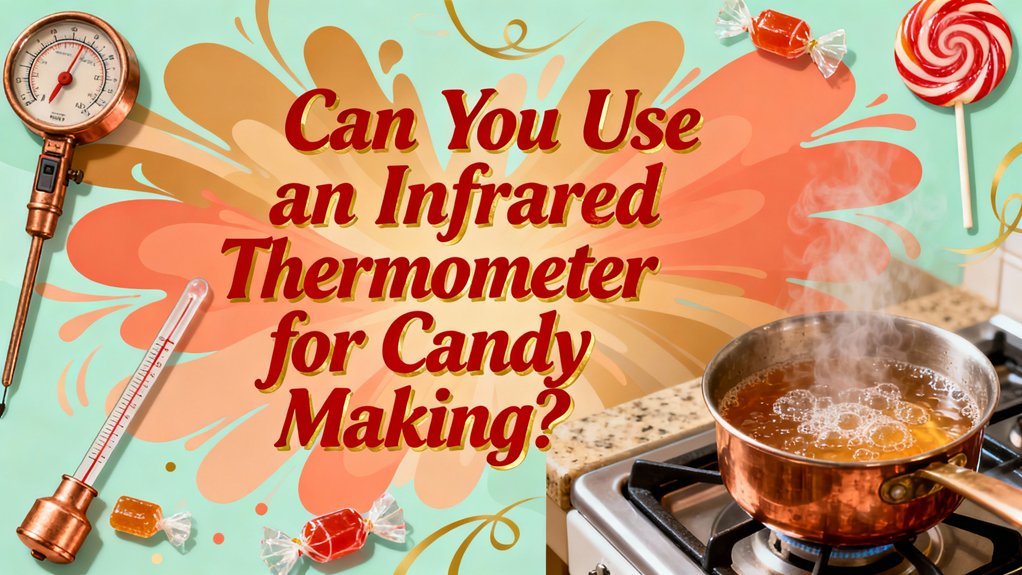
You shouldn’t use an infrared thermometer for candy making because it only measures surface temperature, not the precise internal heat you need for specific candy stages like soft ball or hard crack. Surface readings get distorted by steam, bubbles, and evaporation, while molten sugar’s low emissivity causes significant underestimates. You’ll need a dedicated candy thermometer or digital probe for accurate, reliable results. Understanding why IR thermometers fail—and what works instead—makes all the difference in your success.
Why Infrared Thermometers Fall Short for Boiling Sugar
While infrared thermometers seem like convenient kitchen gadgets, they’ll consistently mislead you when you’re making candy because they can’t measure what actually matters—the internal temperature of your boiling sugar. Infrared thermometers only capture surface temperature readings, which don’t reflect the uniform heat throughout your syrup’s volume. When you’re boiling sugar, you need precise internal temperatures to hit specific candy stages like soft-ball or hard-crack. The surface temperature you’re measuring will be artificially cooled by evaporation and obscured by rising steam and bubbles. Your thermometer can’t penetrate the liquid to gauge the bulk temperature where crystallization actually occurs. Since infrared thermometers measure the emissivity of materials, the varying surface composition of bubbling sugar syrup creates additional reading inconsistencies. Environmental factors like smoke or steam may further interfere with the infrared readings, compounding the measurement challenges during the candy-making process. Proper food preservation techniques, such as those used in freezing salmon, require similarly precise temperature control to maintain quality and safety. Unlike instant-read thermometers that require careful timing, oven-safe probe thermometers are specifically designed to remain in place throughout the cooking process for continuous monitoring. For accurate, safe candy making, you’ll need a probe thermometer clipped to your pan’s side instead.
How Emissivity and Surface Conditions Affect Readings
Because infrared thermometers assume a fixed emissivity value—typically 0.97 for food surfaces—they’ll misread your candy whenever the actual surface deviates from that preset. Molten sugar and caramel have lower emissivity due to their glossy, reflective surfaces, causing underestimated temperatures. Conversely, granulated dry sugar reads more accurately because its matte texture approaches that 0.97 assumption. Surface texture dramatically influences emissivity factors: rough, opaque surfaces emit more thermal radiation than smooth, polished ones. You’ll encounter additional problems when aiming at metal cookware or angled surfaces, which introduce reflected ambient radiation. Condensation, oil films, and sugar crusts further distort readings. Similarly, when using a Dutch oven for candy-making applications, the vessel’s metal surface can reflect ambient heat and complicate infrared measurements. The always-on laser pointer on quality infrared thermometers helps you target the exact candy surface you want to measure, minimizing aiming errors that could compound emissivity-related inaccuracies. Practical verification techniques ensure you can adjust emissivity settings by comparing your infrared readings against a calibrated contact thermometer at known reference points. For reliable candy temperatures, validate your IR thermometer against a calibrated probe thermometer, especially during critical stages like soft-ball or hard-crack.
Practical Challenges When Using IR Thermometers in the Kitchen
Even when you’ve accounted for emissivity issues, infrared thermometers face fundamental limitations that make them unreliable for liquid candy work. Kitchen cooking conditions actively sabotage your readings. Steam and vapor rising from boiling syrup interfere with infrared signals, while splattering candy blocks direct targeting. Ambient heat from your stove influences non-contact measurements, compounding measurement errors.
You’ll struggle with practical handling too. Maintaining the correct distance—typically 2-12 inches—requires a steady hand over a hot pot. Rapid temperature fluctuations during boiling evade instant scans. Battery drain during extended sessions adds frustration. Unlike probe thermometers that insert 3-4 inches into the liquid, infrared devices cannot make direct contact with the syrup to stabilize readings. Just as thermometers designed for oven use must withstand specific temperature conditions, candy thermometers require specialized construction to handle the extreme heat and moisture of syrup work. Infrared thermometers excel at real-time temperature readings in controlled environments, but this application falls outside candy syrup work. For the most accurate results in candy making, digital probe thermometers measure the actual internal temperature of the mixture, ensuring the desired stages are reached. Proper thermometer calibration techniques can help verify accuracy before use, though infrared models remain unsuitable for this particular application.
Most critically, you can’t distinguish between critical candy stages. A soft-crack reading at 270°F versus hard-crack at 300°F demands precision you simply won’t achieve. Specialized candy thermometers are designed to withstand the extreme temperatures exceeding 300°F that candy making requires, ensuring you can reliably identify each stage. Probe thermometers deliver the ±0.5°F accuracy candy making demands.
When an Infrared Thermometer Actually Works Well
Despite their limitations for liquid candy work, infrared thermometers excel in specific kitchen applications where you can leverage their non-contact advantage. Chocolate tempering benefits greatly from quick, accurate readings that prevent overheating and preserve cocoa butter’s crystalline structure, yielding that coveted glossy finish. You’ll find hygienic applications invaluable during frequent temperature checks on hot and cold holding lines, eliminating cross-contamination risks that probe-based methods introduce. For surface measurements on skillets, pans, and grills, you get reliable readiness assessments without contact disruption. The dual-laser technology provides precision across varying textures and distances. When measuring reflective surfaces like stainless steel equipment, apply masking tape to low emissivity areas to ensure accurate readings rather than capturing ambient temperature reflections. When you’re working with delicate chocolate creations or maneuvering through busy food service environments, the non-contact method protects both your product’s integrity and your kitchen’s sanitation standards. Professional chocolate makers in specialized facilities like Hill Country Chocolate rely on precise temperature control to craft handcrafted chocolates that achieve the perfect texture and appearance.
Better Tools and Techniques for Accurate Candy Making
While infrared thermometers shine for chocolate work and sanitation-critical applications, accurate candy making demands tools that deliver direct contact with your syrup throughout the cooking process. Instead, you’ll get reliable accurate measurements with digital probe thermometers or glass-tube candy thermometers suspended by clips above the pot bottom. Pre-warm your thermometer stem to prevent transient cooling that skews readings. Use a heavy-bottomed, light-colored saucepan for even heating and visual monitoring. Calibrate before each batch by checking your thermometer reads 212°F in rolling boiling water. Several thermometer types are available for different candy-making needs, including infrared, oven, grill, candy, refrigerator, and thermocouple thermometers that each serve specific applications. Understanding the narrow temperature ranges for each candy stage—from soft ball at 234°F–240°F to hard crack at 300°F–310°F—ensures you achieve the exact texture your recipe requires. When in doubt, cross-check thermometer readings against candy texture using cold-water droplet tests—soft ball, hard crack stages confirm your instrument’s accuracy and protect your batch from overcooking.