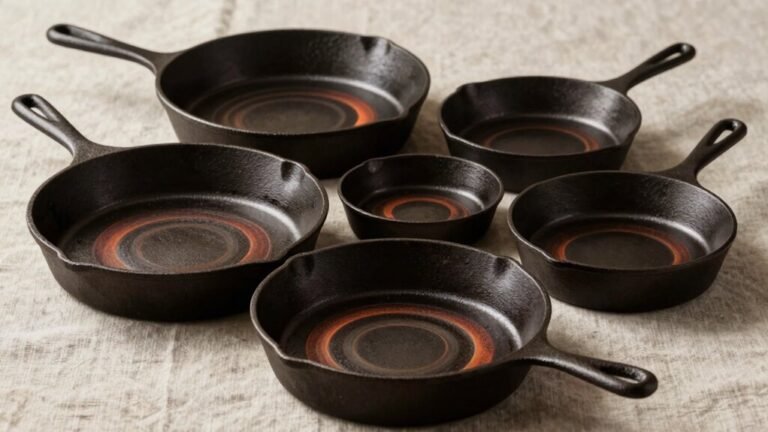

Cast iron’s superior thermal mass sustains temperatures around 425°F, enabling consistent Maillard reactions above 200°C for restaurant-quality crusts. You’ll achieve uniform browning and better heat retention than standard pans, especially with thick cuts. However, you’ll need to manage its weight, maintain seasoning with high-smoke-point oils like beef tallow, and allow proper cool-down to prevent damage. Thinner cuts perform better in carbon steel or stainless alternatives. Your ideal choice depends on cut thickness, fat content, and maintenance commitment—factors worth exploring further.
Why Heat Retention Matters for Searing Steak
When you’re searing steak, heat retention‘s the difference between a restaurant-quality crust and a disappointing gray surface. Cast iron‘s superior thermal mass maintains consistent temperature when cold meat contacts the skillet’s surface, ensuring minimal temperature drop. This stability proves critical for triggering the Maillard reaction uniformly across your steak’s exterior.
You need sustained heat around 425°F to develop that flavorful brown crust without drying the interior. Cast iron’s thick construction preserves this temperature throughout the searing process, enabling deep browning on thick-cut steaks—at least one inch thick. Thinner stainless steel pans can’t match this performance unless you invest in premium options. To ensure food safety and optimal results, use a meat thermometer to verify your steak reaches the desired internal temperature. Preheating your skillet over medium-high heat for several minutes ensures it reaches the optimal temperature before you add oil and your steak. The raised ridges found on grill pans can also create distinctive sear marks while allowing excess fat to drain away from your steak’s surface. For optimal results, avoid nonstick pans during high-heat searing as they cannot produce proper browning and may compromise your crust development. If you’re cooking steak frequently, consider investing in vacuum sealer bags to preserve your meat’s quality between cooking sessions and maintain freshness for future meals. Cast iron’s natural seasoning improves with each use, creating an enhanced natural non-stick surface that supports superior browning performance over time. Unlike stainless steel alternatives, cast iron’s even heat distribution allows for uniformly browned surfaces across the entire steak.
Superior heat retention means you’ll achieve consistent results with each steak, not just the first one cooked in your preheated pan.
The Science Behind Crust Formation
Three chemical and physical processes determine whether you’ll develop that prized mahogany crust or end up with a pallid, unevenly browned surface: the Maillard reaction must occur at sufficient temperature, heat transfer dynamics must sustain contact temperatures above 200°C, and your pan’s surface topography must concentrate that heat where protein and reducing sugars meet.
Maillard dynamics begin when reducing sugars and amino acids collide at roughly 140–165°C, generating melanoidins—the brown pigments defining exceptional crust chemistry. Reaction rates accelerate exponentially above threshold temperatures. Your pan’s thermal mass determines whether contact temperature persists after cold steak makes contact. Cast iron‘s superior heat capacity buffers temperature drops effectively, while stainless steel recovers faster but stores less energy. Surface roughness concentrates pressure and heat at microscopic peaks, nucleating browning patterns. Just as precise temperature control is essential for preserving the quality of delicate compounds during cooking, maintaining optimal pan temperatures ensures proper Maillard reaction progression. Thin oil films optimize conduction without insulating. To measure the precise temperature of your pan’s surface without affecting the cooking process, use an infrared thermometer held at the proper distance to ensure accurate readings. A properly seasoned cast iron surface creates a more durable non-stick layer that enhances heat distribution during the searing process. To maintain your skillet’s seasoning performance, apply a thin layer of oil after each use to prevent rust and preserve the non-stick properties, similar to how refrigerated storage conditions preserve food quality by controlling bacterial growth. Cast iron’s ability to retain heat for even cooking makes it particularly effective for achieving consistent browning across the entire steak surface. Maintaining thin, even oil application prevents sticky surfaces that would compromise heat transfer efficiency. Surface dryness remains non-negotiable—moisture evaporates before Maillard chemistry dominates, delaying crust formation until that water’s completely driven off.
How Seasoning Improves Cast Iron Performance
Cast iron’s superiority in searing steak doesn’t end with its thermal mass—the seasoning layer you build transforms the skillet into an increasingly efficient cooking instrument. Through oil polymerization, you create a durable, non-stick surface that strengthens with each use. This cumulative seasoning benefits your cooking performance substantially.
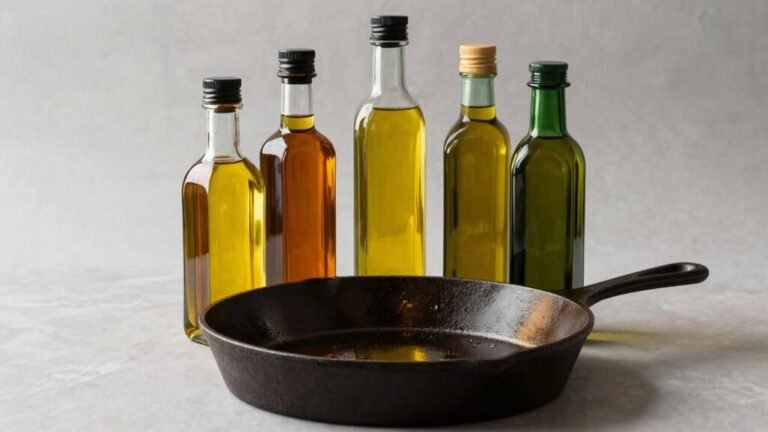
The polymerized oil layer enhances heat retention, enabling consistent, intense searing that maintains temperature throughout your steak’s cooking process. You’ll notice reduced sticking and superior browning as the patina develops. Beef tallow, with its high smoke point, is particularly effective for building durable seasoning layers without burning. Building up multiple rounds of oiling and baking creates increasingly resilient seasoning that withstands high-heat cooking demands. Additionally, seasoning builds surface resilience against wear, extending your skillet’s lifespan indefinitely. Unlike chemical-coated cookware, cast iron seasoning represents a non-toxic alternative that promotes healthier cooking while continuously improving with proper maintenance.
Post-cooking maintenance—drying and applying canola oil—reinforces this protective layer by allowing the seasoning to cure. A scorching hot skillet ensures optimum sear and superior browning results. Medium-heat cooking preserves seasoning integrity while high-heat searing leverages its full potential. You’re not merely cooking; you’re progressively optimizing your tool’s performance.
Achieving Even Cooking Throughout Your Steak
The performance gains you’ve built into your cast iron skillet only matter if you’re maximizing its potential through deliberate technique. Tempering your steak at room temperature for 20–60 minutes minimizes the temperature differential between interior and surface, enabling even doneness throughout. Use the frequent-turning method—flipping every 30–60 seconds—to equalize surface temperature while promoting gradual internal cooking. After initial high-heat searing, lower heat to medium-low for controlled carryover cooking without overbrowning. Consider using the faux dry aging technique by seasoning your steak generously with kosher salt and resting it in the refrigerator for at least 2 hours, which enhances flavor concentration and improves overall searing performance. For indoor cooking, a perforated cast iron grill pan can reduce smoke while maintaining excellent heat retention and distribution. Proper cast iron maintenance through regular seasoning and cleaning will preserve these performance benefits over time. Basting with hot butter and aromatics, spooning liquids across the steak’s top and edges for uniform heat transfer, significantly enhances both flavor and tenderness. After basting, allow the steak to rest for 5–10 minutes before serving to let the juices redistribute throughout the meat. For maximum accuracy in determining doneness, a wireless meat thermometer allows you to monitor internal temperatures remotely without repeatedly opening your oven or stepping away from your grill. Deploy a thermometer to guide timing: 125°F for rare, 130–135°F for medium-rare, 140°F for medium. This precision prevents overcooking and guarantees consistent internal temperature across your steak.
Common Drawbacks and Practical Challenges
While cast iron skillets deliver unmatched heat retention for searing steaks, they’re not without substantial practical limitations that can undermine your cooking experience. Weight concerns make handling treacherous—standard skillets weigh 5–15 pounds, increasing drop and burn risks when transferring between stovetop and oven. You’ll also face maintenance difficulties; seasoning strips away when exposed to acidic deglazes or water, demanding manual cleaning and periodic re-oiling. Cast iron’s slow thermal response creates uneven heating, with hot centers and cooler rims producing inconsistent sears. Additionally, retained heat keeps handles dangerously hot long after cooking, and reactive surfaces absorb flavors from previous dishes, potentially tainting subsequent steaks with metallic or fishy notes requiring aggressive restoration. Unlike traditional non-stick finishes, cast iron requires gradual seasoning to develop its non-stick properties, making it more demanding for novice cooks seeking immediate performance. The rustic presentation benefits of cast iron, which allow you to transition seamlessly from oven to table, can be offset by the practical challenges of managing its weight and heat retention during meal service. To address rust and buildup issues, you can apply a baking soda paste to remove oxidation and restore the cooking surface. The seasoning layer builds through polymerization of oils, which improves with use over time and provides protection against rust and corrosion. For best results when seasoning your skillet, apply a thin layer of oil] while the surface is warm to ensure proper bonding and effective protection. After cooking, always allow your skillet to cool completely before washing to prevent seasoning damage from thermal shock. For optimal results, consider using a cast-iron skillet with frequent flipping to achieve better crust and minimal gradient in your steak’s doneness.
Flavor Profiles: Cast Iron Versus Other Cookware
When you’re searing steak, your choice of cookware fundamentally shapes the final flavor profile through its influence on heat retention, crust development, and browning chemistry. Cast iron’s thermal mass sustains consistent surface temperatures, producing uniform crust texture and accelerated Maillard browning. You’ll notice enhanced flavor complexity when finishing with butter and aromatics—browned milk notes layer into the sear. Proper seasoning techniques maintain cast iron’s non-stick surface and enhance its natural flavor contribution to your steak.
Carbon-steel pans deliver comparable results with faster heat-up times, though temperature response varies. Stainless-steel shows greater fluctuation, potentially yielding uneven browning. Nonstick pans struggle to achieve the same crust intensity due to manufacturer heat limits. Like the slow-cooking process used in Dutch oven roasting, maintaining consistent heat allows your steak to develop deeper browning chemistry through extended contact with the hot surface. Monitoring your steak’s internal temperature ensures you achieve the desired doneness while maintaining the quality sear that your cookware choice enables. The 10-12 inch skillet range provides optimal surface area for searing steaks while maintaining proper heat distribution. For cast iron specifically, the polymerized oil layer created through proper seasoning at high heat temperatures provides the durability needed for consistent high-heat searing performance.
Grills introduce smoky volatile compounds absent from stovetop searing. Cast iron’s retained pan fond creates concentrated savory depths when deglazed, while open-flame cooking produces characteristic charred, woody notes that differentiate the final taste profile entirely. In contrast, cast iron allows for effective basting with butter, which enhances moisture and flavor in ways that grill cooking cannot replicate due to fat dripping through the grates.
Versatility Across Different Steak Cuts
Your choice of cookware doesn’t exist in isolation—it’s dictated by the specific cut you’re searing. Thick steaks like tomahawk or bone-in ribeye demand cast iron‘s thermal mass, which resists temperature collapse when cold meat hits the surface. Conversely, thin cuts—flank, skirt, minute steaks—perform better in carbon steel or stainless, which heat faster and reduce overcooking risk during quick sears.
Cut adaptability extends to fat content. High-marbling cuts benefit from cast iron’s sustained heat during gradual rendering, while lean sirloin requires rapid-heating pans you can easily adjust. Delicate filet mignon needs controlled searing that lighter pans provide without over-crust development. A 3 mm thick carbon steel pan can perform comparably to cast iron at the same thickness, offering similar heat capacity for precise sear control. Proper seasoning with Texas barbecue seasoning before cooking further enhances the crust development across different pan types, similar to how enzyme deactivation preserves food quality during storage. Cast iron’s natural non-stick surface improves with proper seasoning over time, making it an excellent long-term investment for steak preparation. For optimal results, incorporate butter basting with herbs during the final stages of cooking to infuse rich, complex flavors into the crust. Like Dutch ovens, cast iron’s excellent heat retention makes it ideal for maintaining consistent cooking temperatures throughout the searing process. Resting the steak after cooking allows the juices to redistribute throughout the meat, ensuring a more tender and flavorful final result.
Your cooking techniques should align with the cut’s geometry and composition. Uniform steaks achieve even doneness on cast iron’s stable surface, while irregular, fatty cuts tolerate cast iron’s accommodating structure for basting and pan-sauce creation.
Temperature Control and Consistency
The fundamental difference between cast iron and conventional pans emerges most clearly in how they manage heat during the critical searing phase. Cast iron’s superior thermal mass maintains consistent surface temperature when you add steak, particularly benefiting thicker cuts that demand prolonged contact. Thin stainless or aluminum pans experience rapid temperature variability upon steak placement, requiring aggressive burner adjustments to sustain adequate sear.
You’ll achieve better temperature uniformity across cast iron’s cooking surface once fully preheated, eliminating hot and cold spots that compromise crust consistency. This evenness directly translates to predictable internal temperature rise with minimal carry-over risk. To maximize the Maillard Reaction that creates that desirable flavorful crust, preheating your cast iron skillet to approximately 600 degrees Fahrenheit ensures optimal browning. If you’re traveling with your cast iron skillet, remember that cast iron cookware must be packed in checked baggage only. Conversely, conventional pans’ thinner construction and uneven heat distribution force you to manage temperature variability more actively, demanding tighter timing control and frequent monitoring to prevent inconsistent doneness across your steak’s cross-section. Resting your steak after cooking allows the internal temperature to rise approximately 10°F while redistributing juices for optimal tenderness. After the initial searing phase, reducing heat to medium-low temperature allows the inside to cook properly without excessive exterior browning.
Maintenance and Long-Term Durability
Cast iron’s thermal superiority for searing comes with maintenance demands that distinguish it fundamentally from conventional cookware. You’ll develop seasoning techniques through regular use, applying thin oil layers post-cleaning to build a protective non-stick coating. This maintenance proves vital—the seasoning resists rust and strengthens with each cooking session.
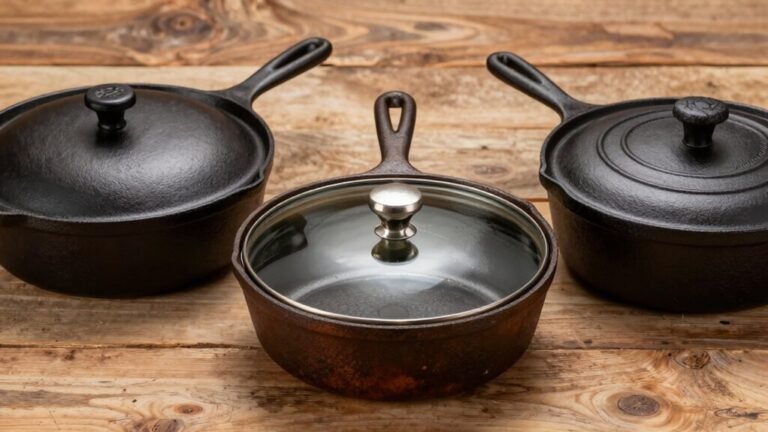
Your rust prevention strategy involves complete drying via stovetop heat, eliminating moisture that causes degradation. Store your pan with airflow or plastic separators between lid and body. Should rust appear, scrub with a stiff brush, rinse, dry thoroughly, and oil immediately. Like the atmospheric pressure principle that seals containers during preservation, the tight seal created by proper seasoning on cast iron protects against oxidation and degradation over time. For stubborn rust situations, using a vinegar spray solution can help remove rust buildup before you proceed with scrubbing and re-seasoning.
For routine cleaning between uses, pour a generous amount of kosher salt into the warm skillet and scrub vigorously with a paper towel to remove food particles, taking advantage of the salt’s coarse texture as a gentle abrasive. For stubborn spots, a chain mail scrubber provides effective cleaning without damaging the seasoned surface. After each cleaning, ensure your cast iron is dried thoroughly with a towel and then lightly coated with cooking oil while still warm to prevent rust formation.
The payoff justifies the effort: proper care guarantees your cast iron lasts generations. Unlike conventional cookware, cast iron cannot be ruined—you can scrape away rust or poor seasoning and restart restoration. Frequent use builds durable seasoning that outperforms initial phases, delivering unmatched steak searing capabilities.
Making Your Choice: Cast Iron or Alternative Pans
Since you’re committing to quality steak searing, understanding how cast iron stacks against competing cookware becomes essential to your decision. Cast iron’s superior heat retention and even distribution directly impact your cooking techniques and final results. While stainless steel offers viability, it produces less uniform doneness. Carbon steel heats faster but requires more skill for consistent browning. Non-stick sacrifices the sizzle and crust quality you’re pursuing.
Your choice hinges on what matters most: versatility, ease of handling, or speed. Cast iron excels across all three for steak specifically. Its oven-safe design supports reverse sear methods and basting techniques. The pan materials you select determine whether you achieve magnificent crusts with minimal temperature fluctuation. For traditional searing excellence, cast iron outperforms alternatives decisively.