
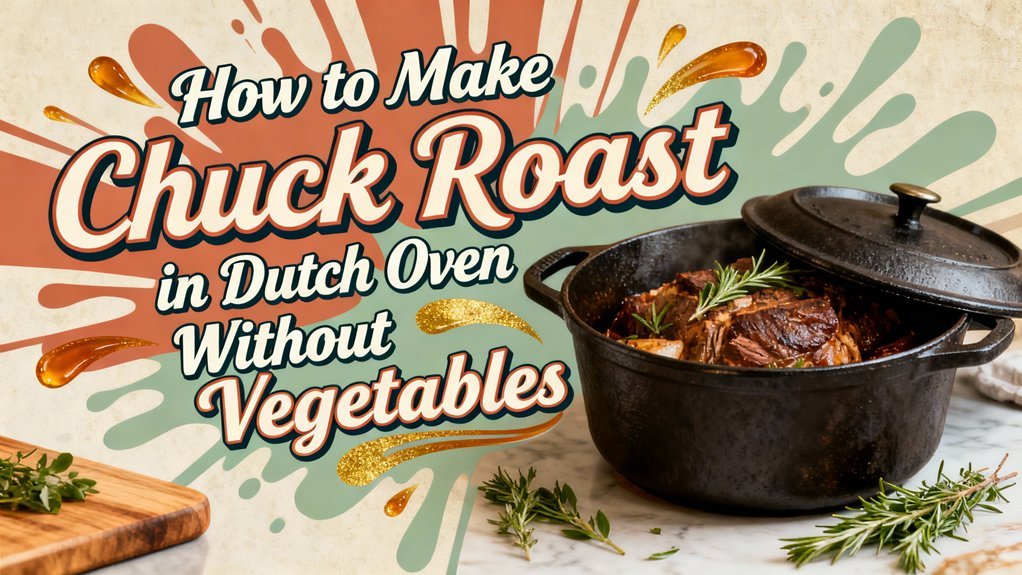
You’ll transform your chuck roast by searing it aggressively in a preheated Dutch oven, then braising it in beef stock and red wine at a 2:1 ratio. Add tomato paste, Worcestershire sauce, vinegar, and aromatics like garlic, bay leaves, and thyme for depth. Maintain 325°F for three to five hours until the internal temperature reaches 200–210°F. Rest the roast for two hours before slicing, then craft a rich gravy from the reserved pan juices. The techniques that follow will refine your execution.
Selecting and Preparing Your Chuck Roast
Understanding your cut’s origin sets the foundation for success. You’ll find that chuck roast comes from the shoulder, an area with heavy muscle use that creates natural toughness. For best results, prioritize cut selection by choosing a 7-bone chuck roast from the primal center, which offers superior quality for Dutch oven cooking.
When evaluating meat quality, look for deep red coloring and bright white marbling throughout. Avoid grayish-brown hues, which indicate prolonged shelf time. You’ll want bone-in options with bright white bones for added flavor development. Local butcher shops often provide higher quality and fresher meat compared to supermarket options.
Request a 2-inch thickness when your butcher cuts the roast. Choose Choice grade beef—it delivers high quality with ideal marbling for slow cooking without excess fat. USDA Choice beef is particularly well-suited for braising and slow-cooking methods that enhance tenderness and flavor. Proper Dutch oven selection, such as a 7 to 8 quart capacity, ensures adequate space for heat circulation during the slow-cooking process. Finally, pat your roast dry and season generously with Montreal Steak seasoning before searing.
Essential Equipment and Vessel Setup
The Dutch oven—your primary cooking vessel—determines whether your braise succeeds or fails, making proper selection and setup non-negotiable. Select enameled or seasoned cast iron for superior thermal mass and even heat distribution. Verify your pot holds at least 1 quart per pound of roast, allowing adequate braising liquid and air circulation.
Confirm the lid fit is tight; this traps moisture and maintains the low-oxygen environment essential to braising. Check that your vessel’s oven-safe rating accommodates your target temperature of 250–325°F, including handles and trims. Quality Dutch ovens demonstrate exceptional heat retention properties that are crucial for maintaining consistent cooking temperatures throughout the braising process. Like cast iron skillets used for baking, properly preheated Dutch ovens should reach evenly heated conditions before searing meat to ensure optimal crust formation and cooking results. For long-term durability and food safety, ensure your Dutch oven and any food storage containers are BPA-free construction to prevent chemical leaching into your food during extended cooking or storage. Well-designed handles on Dutch ovens provide safe lifting and maneuvering when dealing with the heavy pot filled with braising liquid and meat.
Before cooking, preheat your Dutch oven on the stovetop over medium-high heat while your oven reaches braising temperature. This dual preparation minimizes temperature loss when you sear the roast and maintains consistent braise conditions throughout cooking. For optimal results, ensure your Dutch oven reaches the proper searing temperature before adding the seasoned chuck roast to achieve a flavorful crust. An infrared thermometer allows you to quickly verify your Dutch oven has reached the target temperature without opening the lid or interrupting the heating process. The excellent heat retention of your Dutch oven ensures that your chuck roast becomes tender, moist, and juicy throughout the braising process.
Seasoning and Pre-Searing Technique
Pat your chuck roast completely dry with paper towels; surface moisture inhibits browning and promotes steaming. Apply kosher salt at 0.8–1.5% of meat weight—roughly 16–30 grams for a 2-kilogram roast—evenly across all surfaces. Add coarse black pepper and a umami element like smoked paprika for seasoning balance. Coat the roast lightly with high-smoke-point oil to guarantee uniform heat transfer during searing. For optimal results, use Cattleman’s Grill California Tri-tip Seasoning as your primary seasoning blend to ensure consistent flavor development throughout the braising process.
Once your Dutch oven’s oil shimmers, sear the roast aggressively on all sides, rotating every two minutes. This moisture control technique develops the Maillard reaction that delivers flavor depth your braise demands. Proper surface moisture removal during preparation prevents steaming and ensures the browning necessary for complex flavor development in your finished dish.
Building Your Braising Liquid
Now that you’ve built your flavorful crust, you’ll construct a braising liquid that extracts every ounce of collagen from the roast while developing the rich, complex sauce that defines an exceptional braise.
Start with beef stock as your primary liquid type, combining it with red wine at a 2:1 ratio for depth and acidity. Deglaze your seared pan immediately, scraping up fond to incorporate into your liquid base.
Layer flavor enhancement through tomato paste (1–2 tbsp), Worcestershire sauce, and a splash of vinegar. Add aromatics—smashed garlic cloves, bay leaves, thyme, and rosemary sprigs—directly to the liquid. For optimal results, sear the beef for 7-10 minutes until a deep brown crust forms to enhance the flavor of your braising liquid. Maintaining precise temperature control throughout the braise ensures the collagen breaks down evenly and the sauce develops consistent depth. Using a quality oven-safe braiser will help retain moisture and maintain even heat retention and distribution throughout the cooking process. Place your Dutch oven in the oven as it preheats so both heat up gradually together, avoiding thermal shock that could damage the pot. The finishing touch of rich gravy made from the cooking liquid transforms your braising base into an exceptional sauce worthy of the meat itself.
Pour enough liquid to reach one-third to two-thirds up your roast. Under-season initially using low-sodium stock, then adjust after reduction. This measured approach, combined with proper food safety practices, guarantees balanced, concentrated flavor without over-salting while ensuring your braise remains fresh and safe to enjoy.
Braising Method and Oven Temperature Guide
After you’ve built your braising liquid and positioned your seared chuck roast in the Dutch oven, you’ll want to establish the right oven temperature and timing to transform tough collagen into silky gelatin. Set your oven to 325°F for ideal braising techniques—this moderate temperature balances cook time with tender results. For a 3 lb roast, expect 3–5 hours at this setting. Your oven settings directly impact outcome: lower temps (275–300°F) extend cooking but preserve moisture; higher temps (350°F) reduce time to 3–3.5 hours but demand closer monitoring. Maintain consistent oven temperature using a wireless meat thermometer for precision. Red wine and Dijon mustard in your braising liquid will enhance the meat’s flavor and tenderness throughout the cooking process. This slow-cooking method transforms chuck roast into fork-tender meat through patient, low-temperature braising. Cover the dutch oven with a lid during cooking to trap steam and ensure even heat distribution throughout the braising process. For best results, follow a stovetop-to-oven transition by searing your meat on the stovetop before transferring to the oven. Many Dutch oven recipes incorporate pepperoncini peppers and juice along with seasoning mixes to create a tangy, buttery sauce that complements the tender meat. The extended simmering time allows browned bits to deglaze and infuse the braising liquid with deep, savory notes. Check doneness at the lower time estimate using a fork-tender test, then adjust accordingly to prevent overcooking.
Monitoring Doneness and Cook Time
Because collagen breakdown doesn’t follow a strict timeline, you’ll rely on internal temperature combined with tactile tests to determine when your chuck roast reaches ideal tenderness. Insert an instant-read thermometer into the thickest part of the meat, avoiding bone and fat. Target 200–210°F for shredding; 195–205°F for slicing. Temperature monitoring serves as your objective baseline, but don’t stop there. Perform fork and toothpick tests—the meat should pull apart easily with minimal resistance. A three to four-pound roast typically braises for 2.5–4 hours at 300–325°F, though oven variability and Dutch oven material considerably affect timing. To ensure accuracy throughout the cooking process, calibrate your thermometer periodically to verify it provides correct readings. For the most reliable measurements, position your thermometer perpendicular to the thickest part of the meat to ensure proper contact and avoid angled readings that could skew results. Unlike instant-read thermometers, oven-safe probe thermometers are designed to remain in the meat throughout the entire cooking process for continuous temperature monitoring. Consider using thermometer models with wireless connectivity options to monitor your roast’s temperature from a distance without opening the oven door frequently. Prioritize doneness indicators over clock time. Many traditional braises, such as pork roast with sauerkraut, employ similar collagen breakdown techniques to achieve the desired tender texture. Once you’ve reached target temperature and confirmed tenderness tactilely, remove the roast and rest it 10–15 minutes before carving, allowing the internal temperature to stabilize and enhance juiciness. For optimal results, aim for 210 degrees F when shredding to ensure maximum tenderness and ease of separation.
Resting, Slicing, and Gravy Preparation
Once your chuck roast hits the target temperature and passes the fork-tender test, you’ll want to remove it from the Dutch oven and let it rest before cutting. A resting duration of 2 hours allows intramuscular fat to redistribute and reabsorb lost moisture, ensuring ideal tenderness. Resting in a 180° oven or cooler will further enhance the meat’s ability to retain its juices and develop optimal flavor. The internal temperature should decrease to around 145°F during this resting period for optimal results.
Wrap your roast in foil during this period. After resting, unwrap and employ your preferred slicing techniques—slice, pull, or chop based on your serving preference. The meat should reach 203-210°F, remaining sliceable yet tender. To verify doneness during cooking, consider using an oven-safe meat thermometer inserted at least 2 inches into the meat while it cooks. A cast iron Dutch oven provides excellent heat retention for achieving consistent results throughout the cooking process. Pairing your Dutch oven preparation with root vegetables like potatoes, carrots, and onions can add depth and nutrition to your meal. During the cooking process, deglazing with red wine and beef broth creates a savory cooking liquid that enhances the roast’s rich, complex flavors.
For gravy preparation, reserve the accumulated pan juices from your Dutch oven. Enhance this base with broth inclusion of 1/2 to 1 cup beef broth if additional liquid’s needed. These drippings create a rich, flavorful sauce for your finished dish.
Storage, Reheating, and Food Safety
Your chuck roast doesn’t end when you’ve finished serving—proper storage, reheating, and food safety practices guarantee you’ll safely enjoy leftovers for days or even months.
For refrigerator storage tips, keep cooked roast beef in airtight containers at 40°F or below for three to four days. For freezer storage, wrap it in foil or freezer paper and store at 0°F for two to three months. Remove air from freezer bags to prevent freezer burn, as removing air from packaging significantly extends the shelf life of your frozen meat. Consider using vacuum sealing technology for even better protection against freezer burn and oxidation during long-term storage. Vacuum sealing locks out air and moisture to slow spoilage and maintain food quality throughout extended freezer storage. Vacuum sealing also helps with efficient food organization by compressing packages and saving valuable freezer space. Labeling your vacuum sealed bags with dates and contents helps you track storage duration and identify exactly what you’ve frozen. Discard any leftovers that have been left out of the refrigerator for over 2 hours, as this significantly increases the risk of pathogen growth regardless of whether you refrigerate them afterward.
When you’re ready to eat, employ these reheating techniques: use your oven, stovetop, or microwave, heating to 165°F internal temperature. Cover the roast during reheating to retain moisture. Never taste questionable meat. When in doubt, discard it immediately to avoid foodborne illness. Wash hands with soap and water before handling any leftover roast to prevent cross-contamination with other foods.