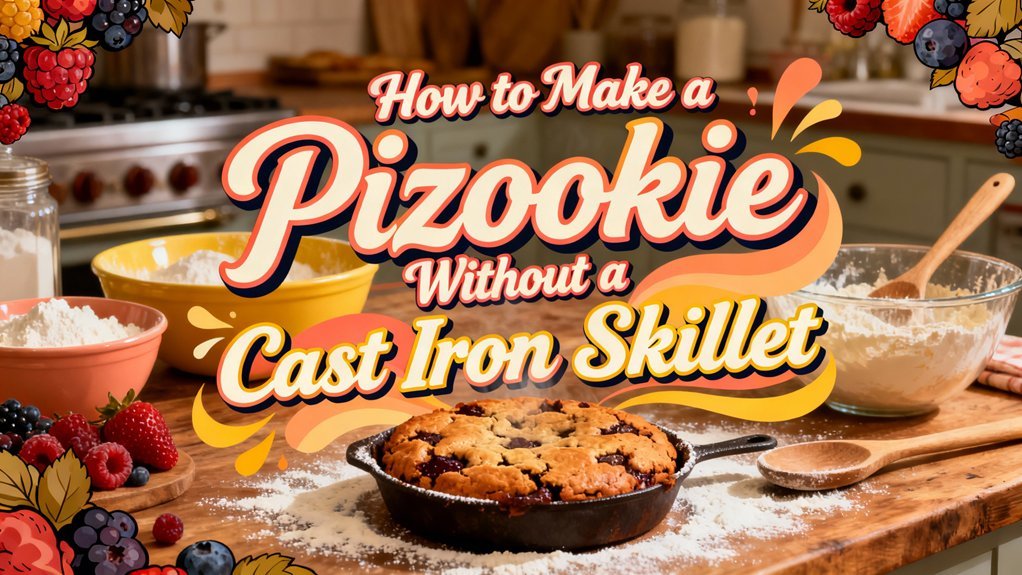
You don’t need cast iron to make an amazing pizookie. Grab a 10-inch springform pan, aluminum baking dish, or ceramic cake pan instead—they’re honestly easier for removal. Prepare your pan with the grease-and-flour method, mix your dough with room-temperature ingredients, then spread it evenly for uniform thickness. Bake at 350°F until the edges turn golden-brown while the center stays gooey. Top with vanilla ice cream or salted caramel while it’s warm. The right technique and pan choice really do make all the difference.
Understanding Alternative Bakeware Options
When you don’t have a cast iron skillet on hand, you’ve got plenty of bakeware options that’ll give you a delicious pizookie—you just need to know how each one affects your bake. Alternative materials like aluminum, stainless steel, glass, and ceramic all conduct heat differently, impacting browning speed and texture. Heavy-gauge aluminum heats quickly and distributes warmth evenly, while stainless steel requires minor time adjustments. Glass and ceramic provide gentle, steady heat but need lower oven temperatures to prevent overbrowning. Nordic Ware natural aluminum pans yield ideal heat conductivity for perfectly golden results. Silicone transfers heat less efficiently, often demanding longer bake times. For health-conscious bakers, it’s important to avoid traditional nonstick materials like Teflon that can release harmful chemicals at high temperatures. Understanding these baking efficiency differences helps you choose the right vessel and adjust your recipe accordingly, ensuring your pizookie turns out perfectly chewy or crispy—however you prefer it.
Preparing Your Cake Pans and Round Molds
Since you’re making a pizookie in a regular cake pan instead of cast iron, you’ll want to prep your vessel carefully so your dessert slides out perfectly without sticking. For cake pan preparation, I’d recommend the grease-and-flour method. Spread a thin, even coat of butter across the entire interior, then add a tablespoon of all-purpose flour. Shake and tilt your pan to coat all surfaces evenly, tapping out excess to prevent clumps.
For round mold techniques, consider using parchment paper on the bottom for extra insurance. Cut a circle to fit, place it in your greased pan, then lightly grease the parchment too. This dual-layer approach works beautifully for pizookies since you’re inverting them onto plates. Just as proper air removal techniques ensure food is fully submerged during cooking, proper pan preparation ensures your pizookie bakes evenly without pockets of sticking. Using airtight sealing techniques similar to those used in food preservation can also help protect your baked goods from drying out once they’re plated. To maintain your cake pans in excellent condition, you can clean them effortlessly using baking soda and warm water. Incorrect prep can ruin an otherwise perfect dessert, so take your time ensuring all surfaces are properly prepared. A light coat of oil applied after cooking and cleaning helps prevent rust and maintains the longevity of your bakeware. The barrier between batter and fat] prevents absorption and helps your pizookie release cleanly. Maintaining a clear line of sight to your pan’s interior while greasing ensures you don’t miss any spots that could cause sticking. Your dessert’ll release cleanly every time.
Essential Ingredients for Perfect Pizookie Dough
To nail that perfect pizookie texture—gooey center with crispy edges—you’ll need to balance your dry ingredients, fats, and mix-ins with precision. Start with all-purpose flour, weighed or measured using the spoon-and-level method to avoid dryness. Combine brown and granulated sugar in roughly equal amounts; dark brown sugar adds deeper caramel notes. For leavening agents, use about 1/4 teaspoon baking soda per batch to achieve that golden crust while preserving gooeyness. Room-temperature eggs and melted butter create structural balance and tenderness. Add 1–2 teaspoons vanilla extract to amplify flavor, then fold in semisweet chocolate chips or chopped chocolate chunks gently. A pinch of fine sea salt enhances chocolate flavor beautifully. Like the Mountain Man Breakfast’s customizable ingredients, pizookies can be adapted with various mix-ins and toppings to suit your preferences, much like how slow-roasted pot roasts can be customized with different vegetables and seasonings. When using cast iron cookware, the electrical current reverses rust that may have accumulated on the surface before cooking. To prevent flash rust from forming on cast iron surfaces, apply your seasoning oil while the skillet is still wet. Like a Dutch oven pot roast that braises slowly to develop rich, complex flavors, pizookies benefit from slow cooking in cast iron to achieve their signature molten center. This combination delivers the molten center you’re after, which is the defining characteristic that makes a pizookie distinct from a traditional baked cookie.
Mixing Your Butter and Sugar Base
Getting your butter and sugar base right sets the foundation for that perfect pizookie texture, so don’t skip this step. Start by melting your butter in a small saucepan or microwave-safe bowl—you’re aiming for a liquid, golden base. Remove it from heat and whisk in your sugars until smooth. This melt-and-whisk approach works beautifully because it dissolves the sugars partially and integrates your wet ingredients efficiently. Here’s the important part: let that mixture cool for about 5–15 minutes until it’s just warm to the touch. This butter temperature prevents your eggs from scrambling when you add them next. The sugar roles are essential too—granulated sugar promotes spread and crisp edges, while brown sugar adds moisture and chewiness. For even richer flavor, consider browning your butter before mixing it with the sugars to create that distinctive nutty, caramel-like depth. Just as slow-roasting techniques require precise temperature control to achieve tender, flavorful results, managing your butter temperature is critical to your pizookie’s final outcome. Just as proper temperature management ensures success in other baking applications, controlling your butter temperature is critical to your pizookie’s final outcome. Finding your ratio balance controls your final texture. Just as a golden crust comes from proper heat management in skillet cooking, achieving the right texture in your pizookie depends on careful attention to your ingredient ratios and temperatures. When working with heat and timing, ensure your setup is similar to working in a well-ventilated area where you can safely monitor your ingredients without distraction. Remember that baking powder and baking soda are not interchangeable, so ensure you’re using the correct leavening agent specified in your recipe for the best rise and texture in your pizookie.
Combining Eggs and Dry Ingredients
Now that your butter and sugar base is cooled and ready, you’ll add your eggs—and this is where patience pays off. Room-temperature eggs incorporate more seamlessly into your melted butter, guaranteeing even protein distribution throughout the batter. Whisk your eggs lightly before adding them, then stir them in gradually to prevent curdling.
Next, sift your flour, leaveners, and salt together. This guarantees even distribution and avoids pockets of uneven rise. Add your dry ingredients in stages, stirring gently until no streaks remain. Resist the urge to overmix—high-speed blending develops gluten unnecessarily, toughening your dough. You’re aiming for that tender-chewy balance that makes a pizookie irresistible, achieved through the combination of browned butter and brown sugar that creates the signature soft, gooey texture. Similar to how enzyme deactivation prevents unwanted texture changes in frozen foods, gentle mixing allows ingredients to fully incorporate without overdeveloping gluten structure. Just as trapping steam] during baking helps develop optimal texture in bread, careful ingredient preparation ensures your pizookie achieves the perfect balance of structure and moisture. A tight-fitting lid on your baking vessel can help retain moisture and heat throughout the cooking process. For optimal results, use only 2 tablespoons of beaten egg to avoid an eggy taste that can overpower the chocolate chips. When using browned butter, remember that butter has a smoke point of just over 300 degrees Fahrenheit, so keep your heat moderate to preserve its delicious flavor. Stop mixing once everything’s combined.
Adding Chocolate Chips and Mix-Ins
This is where your pizookie transforms from simple cookie dough into something truly indulgent. You’ll want to fold in about 1 cup of semi-sweet chocolate chips, which provides that classic cookie texture and balanced sweetness. Using proper mix in techniques matters here—grab a rubber spatula and stir by hand rather than using a mixer. This prevents overmixing while ensuring even distribution.
Consider adding 2 ounces of chopped chocolate chunks alongside your chips for extra gooey pockets. You’ve also got flexibility with chocolate chip varieties: try white chocolate, peanut butter chips, or even chopped candy bars like peanut butter cups for creative twists. For best results, aim to fold in your mix-ins until the dough just comes together, which maintains the softness that makes pizookies distinctly underbaked in the center. You can also substitute these mix-ins with other candies such as M&Ms for a fun variation on the classic recipe.
Reserve about 10-20% of your mix-ins for sprinkling on top after you’ve spread the dough, as proper mix-in distribution ensures even coverage and prevents waste. Keeping your ingredients fresh before baking is essential, and vacuum sealing can help preserve chocolate chips and other mix-ins at peak quality. For environmentally conscious bakers, reusable silicone bags offer a sustainable alternative to traditional plastic storage for your ingredients. The visual appeal of properly distributed toppings is enhanced by the polymerized protective layer that forms when baking at the right temperature. This creates those crispy edges and stunning visual appeal that make pizookies irresistible.
Spreading and Pressing Dough Evenly
Once you’ve got your chocolate chips folded in and those reserved mix-ins set aside, you’re ready to transfer your dough to the pan. Place your dough in the center of your prepared skillet, then use a rubber spatula to press it outward gently. Work from the middle toward the edges, ensuring you achieve that perfect dough consistency—soft and even throughout.
For thickness control, spread your dough to about half the pan’s depth, allowing room for rising. Press firmly but carefully across the entire bottom, leveling the surface to avoid air pockets. Uniform thickness guarantees even baking, so take your time here. Your patience pays off when every bite bakes perfectly, with crispy edges and a gooey center. Using a meat thermometer to check the internal temperature of your pizookie ensures it’s fully baked through while maintaining that desired gooey center. If you’re using a round cake pan instead of a cast iron skillet, follow the same spreading technique to ensure your pizookie bakes evenly and rises properly. A 10″ cast iron skillet is the traditional choice for achieving optimal heat distribution and that signature caramelized texture around the edges.
Selecting the Right Oven Temperature
Because your pizookie’s success hinges on balancing a crispy, caramelized edge with a warm, gooey center, you’ll want to nail your oven temperature before sliding that pan in. Start at 350°F for most non-cast-iron pans—it’s your reliable baseline. However, adjust based on your specific pan material. Glass and ceramic retain heat differently than cast iron, so drop to 325°F to prevent overbrowned edges with underbaked centers. Dark nonstick pans? Reduce by 15–25°F since they absorb extra radiant heat. Using convection? Lower your temperature 20–25°F. These adjustments guarantee baking consistency across different cookware, much like how recipe scaling adjustments ensure success when using alternative equipment sizes. For a 10.25-inch skillet, plan for approximately 30-35 minutes of baking time as your standard reference point. The pizookie should be baked until golden brown while maintaining that signature soft, gooey texture throughout. To verify your pan’s heat absorption characteristics, you can use an infrared thermometer to check your cookware temperature before baking, ensuring accurate oven calibration across different pan materials. Similar to how proper internal temperature measurement ensures safe and consistent cooking results, monitoring your pan’s heat distribution prevents unevenly cooked desserts. Like the fermentation process in no-knead bread recipes, allowing time for proper heat distribution in your pan ensures even cooking throughout. Place your pan on the middle rack, centered for even heat distribution, and aim for edges turning golden while the center stays slightly jiggly—around 30–40 minutes depending on your setup. Always ensure your baking equipment is free from flammable hazards that could compromise safety during the high-heat cooking process.
Monitoring Baking Time for Ideal Texture
The hardest part of making a pizookie isn’t the dough or the filling—it’s resisting the urge to pull it out of the oven too early. You’ll want to rely on visual doneness indicators: golden-brown edges with a paler, slightly glossy center. Since you’re skipping cast iron, pan size considerations matter greatly. Smaller pans need longer bake times; larger ones bake faster. Use touch tests importance by gently jiggling the pan—you’re aiming for a slow wobble, not raw slosh. Don’t skip baking temperature adjustments; non-cast-iron skillets brown differently, so monitor those final minutes closely. Just as braising develops rich sauces through careful temperature management, precision in monitoring your pizookie’s doneness will elevate the final result. Proper seasoning with fat layering techniques can enhance non-traditional baking vessels similarly to how cast iron develops its non-stick properties over time. Remember carryover cooking effects continue after removal, so let your pizookie rest 5–15 minutes, just as you would allow proper resting time for proteins to retain their juices. Alternative baking techniques like checking an instant-read thermometer at 180–190°F guarantee perfect gooeyness. A 10-inch springform pan serves as an excellent alternative if you lack a traditional skillet, providing similar results to cast iron while allowing for easier removal.
Serving Your Pizookie With Toppings and Variations
Your pizookie’s real magic happens the moment it hits the table—that’s when you transform a warm, gooey masterpiece into something unforgettable. You’ve got endless topping options to explore. Start with the classics: vanilla ice cream melting into the warm dough, salted caramel drizzle, and hot fudge sauce creating that perfect sweet-salty contrast. Then layer on toffee bits for crunch and whipped cream for lightness. For the best experience, serve warm with your chosen toppings to ensure the ice cream melts perfectly into the soft center. Blue Bell ice cream pairs exceptionally well with freshly baked pizookies for an authentic Texas treat. Allowing your pizookie to rest for a few minutes after baking lets the internal temperature rise slightly while the structure sets, similar to how resting meat allows juices to redistribute for optimal texture. To prevent moisture from compromising your toppings, proper seal strength between layers helps maintain texture integrity throughout serving.
Ready to get creative? Try flavor variations that’ll surprise your guests. You can mix chopped Oreo cookies into your dough, swap chocolate chips for peanut butter chips, or stuff Reese’s cups inside. For optimal results with temperature-sensitive toppings like ice cream, consider using infrared temperature measurement to verify your pizookie has cooled to the ideal serving temperature. Stack Rocky Road ice cream on peanut butter dough, or go bold with Nutella-stuffed brown butter chocolate chip. Each combination delivers a completely different experience, so you can keep experimenting until you unearth your signature pizookie. Traditional cast iron skillets, whether modern reproductions or vintage models, offer excellent heat retention properties that help maintain your pizookie’s ideal serving temperature throughout the meal.