
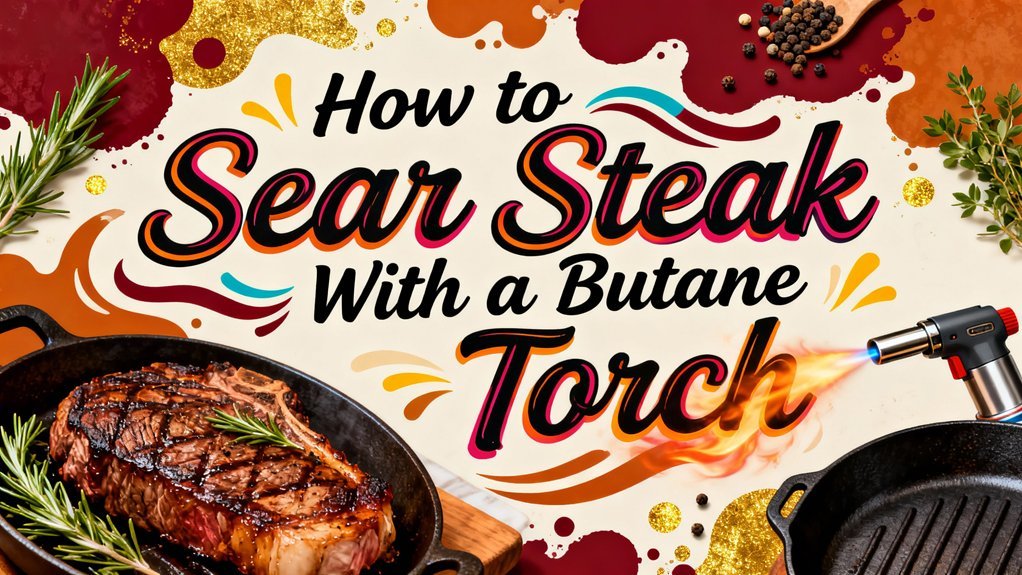
You’ll dry your steak thoroughly and salt it 40 minutes prior for ideal Maillard reactions. Position your Iwatani PRO2 or Bernzomatic TS8000 one finger-length away, using smooth, sweeping motions across the surface for 30 seconds per side. Maintain a whitish-blue flame and keep torch exposure under 2-3 minutes total. Use an instant-read thermometer to hit 125°F for medium-rare, accounting for carryover cooking. Rest your steak 3-5 minutes before serving. Mastering the specific positioning and timing nuances will elevate your results considerably.
Safety Precautions and Equipment Setup
Before you ignite your butane torch, you’ll need to establish a safe workspace that eliminates hazards and protects both you and your surroundings. Start by clearing flammable materials—paper, fabric, solvents, and aerosols—from your searing area. Guarantee proper ventilation to prevent butane vapor accumulation. Position your heat-resistant, stable work surface away from edges to prevent accidental torch falls.
Your protective gear is equally essential. Wear safety glasses to shield against sparks and intense light. Choose heat-resistant gloves when handling heat-conducting materials, and select clothing made from natural fabrics that won’t melt or ignite. Keep a fire extinguisher nearby for emergencies. Tie back your hair to prevent it from catching fire or burning near the flame. Using a raised pan or rack can prevent heat from directly scorching underlying materials and reduce fire hazards.
Finally, inspect your torch for cracks, loose connections, or damaged components before beginning. Check that the spark wire shows visible copper for reliable ignition. Before refilling your torch, ensure it is turned off and cooled down to prevent safety hazards. Learning to control flame intensity helps you achieve even heating without over-browning or creating bitter flavors on your steak. Always use a fire-safe surface such as a cast iron skillet to contain heat and minimize fire risks during the searing process. Proper refillable tank maintenance ensures your torch operates safely and efficiently throughout repeated use.
Selecting the Right Torch and Fuel
Once you’ve secured your workspace and protective equipment, choosing the right torch and fuel becomes critical to achieving proper crust formation on your steak.
For torch selection, the Iwatani PRO2 excels for indoor searing with butane canisters, delivering clean burns ideal for dry-aged ribeyes. However, the Bernzomatic TS8000 outperforms it in crust development, while the BZ4500HS offers a wider flame for broader surface coverage. Testing both torches on prime quality bone-in ribeyes that have been dry aged for 28 days demonstrates the importance of torch selection in achieving professional searing results. Maintaining a distance of about 12 inches from the meat ensures optimal performance and prevents overcooking the exterior. Like selecting the appropriate equipment for other culinary tasks, choosing the right torch based on frequency of use and personal preferences will significantly impact your results. Just as cast iron skillets with legs require careful consideration of leg height and size when selecting traditional cookware, torch selection similarly demands attention to your specific cooking needs. For safety and consistent results, always ensure you work in a well-ventilated area when using your torch. Allowing your steak to reach room temperature before searing ensures even heat distribution and more consistent crust development across the meat’s surface.
Regarding fuel types, butane canisters pair effectively with the Iwatani for controlled, residue-free burns. The TS8000 adapts to propane fuel, generating superior heat output. For best results, MAP/Pro propylene fuel burns hotter and produces complete combustion—evidenced by high-output blue-white flames rather than incomplete yellow ones that impart unwanted fuel taste to your meat.
Preparing Your Steak for Torching
Since proper surface preparation determines whether you’ll achieve an even, flavorful crust or uneven charring, you’ll want to dry your steak thoroughly and season it strategically. Apply coarse salt 40 minutes to 24 hours before torching—this timing window enables ideal dry brine action and moisture control without excessive dehydration. Pat your steak’s surfaces completely dry with paper towels to remove any juices that inhibit Maillard reactions. Trim excess loose fat that’d drip and flare, but preserve a thin cap for rendering. Score fat edges lightly to promote even rendering. Remove any surface film, marinade, or water so the torch flame contacts dry proteins efficiently. Avoid wet marinades immediately before torching, as surface moisture prevents rapid browning and causes uneven charring. The fat cap should be preserved because oily and fatty parts of meat react well to flame, enhancing smokiness and flavor development. For optimal results, ensure you’re using a propane torch rather than a butane alternative, as propane provides significantly higher temperatures necessary for achieving the intense sear that prevents overcooking the inside while caramelizing the exterior.
Mastering Torch Technique and Positioning
With your steak properly prepped and seasoned, you’re ready to execute the torch work that’ll transform that dry surface into a caramelized crust. Position your torch 2-4 inches from the meat surface, where the flame’s hottest zone concentrates maximum heat. Adjust your flame control via the top dial to produce a whitish-blue flame at moderate-high settings for intense, consistent output.
Execute smooth, sweeping motions across the steak’s surface, moving steadily from edge to edge at a controlled pace. Vary your searing angles slightly to guarantee even browning across all contours. Maintain constant motion for 30 seconds per side—stationary flames cause uneven charring. This technique activates the Maillard Reaction, which develops deeper, more complex flavors beyond simple surface browning. Render fat quickly with precise positioning. Remember to keep the torch nozzle one finger-length away from the meat to prevent excessive charring and ensure optimal heat distribution. After searing both sides, flip and repeat, allowing the torch’s intense heat to develop that coveted crust efficiently.
For best results, consider using a pre-seasoned cast iron skillet as your base surface to complement the torch’s direct heat application. After searing both sides, flip and repeat, allowing the torch’s intense heat to develop that coveted crust efficiently.
Achieving Perfect Doneness Levels
The torch’s intense heat means you’ll need precise temperature control to nail your target doneness, as carryover cooking‘ll continue raising the internal temperature even after you’ve removed the steak from the flame. Use a reliable meat thermometer as your temperature guide—it’s non-negotiable for consistency.
For medium-rare, the most popular choice, remove your steak at 125°F to reach 130°F after resting. Medium requires pulling at 135°F–136°F for your final 140°F–145°F target. Watch your doneness indicators carefully: rare steaks display cool red centers, while medium-rare shows warm red centers with brown crusts. Instant-read digital thermometers provide the most accurate temperature readings when inserted into the thickest part of the steak. Resting your steak for 3-5 minutes after torching allows the temperature to increase naturally, which is crucial for achieving your target doneness without overcooking. Similar to how retaining slight air pockets helps bread maintain its texture, allowing your steak to rest preserves its internal moisture and juiciness. Proper heat retention during the resting period ensures your steak maintains its ideal temperature throughout the carryover cooking process.
Well-done steaks reach 160°F–165°F but sacrifice tenderness and juiciness. Remove from heat slightly below your target temperature, accounting for residual heat during the resting period. Unlike oven-safe probe thermometers designed to stay in meat throughout cooking, instant-read thermometers should only be inserted near the end of the cooking process for accurate readings. Programmable alarms can help alert you when approaching your target temperature. The probe should be inserted deep enough—generally at least up to the metal notch or about half an inch—without poking through the other side.
Timing and Temperature Management
Mastering the torch sear hinges on understanding how heat exposure translates to surface browning and interior temperature rise—a balancing act that’ll make or break your final result. Your timing windows are critical: sear immediately after pat-drying to maximize browning, then rest 3–7 minutes to redistribute juices without significant carryover cooking. Unlike the convenience of one-pan skillet meals, precision searing with a torch demands careful attention to the exact moment when the Maillard reaction occurs on your steak’s surface.
For temperature control, start your steak 2–5°F below target doneness before torching to account for residual heat gain. Use an instant-read thermometer to verify baseline and post-sear temperatures, quantifying the actual rise. Keep cumulative torch exposure under 2–3 minutes for thin-to-moderate steaks. Brief 20–60 second passes per face, combined with 5–15 second edge flashing, deliver controlled Maillard development while preserving your perfectly cooked interior. An industrial-grade blowtorch provides consistent heat output necessary for even browning across all surfaces of the steak. Proper temperature monitoring during the searing process mirrors the precision required in food safety protocols to prevent unwanted thermal damage to your steak. Prepare suitable landing spots for your hot steak and equipment to avoid burns during the searing process.
Troubleshooting Common Torching Problems
Even when you’ve nailed your timing and temperature management, torch problems can sabotage your sear—and most stem from flame characteristics, fuel issues, or equipment mismatches.
A yellow or sooty flame signals incomplete combustion, depositing unburned hydrocarbons that create off-flavors. You’ll want a blue, short, roaring flame instead. Weak or flickering flames typically indicate low fuel levels, poor-quality butane, or a clogged nozzle. Address this by cleaning nozzles thoroughly or switching to high-purity fuel. The blue flame’s higher temperature allows you to form a crust quickly without overheating the steak’s interior. Proper flame adjustment is crucial before you begin searing to ensure optimal combustion and flavor quality, similar to how evenly moving the flame ensures consistent caramelization in precision cooking.
Combustion issues often arise from moisture in your canister or loose connections—reseat the fuel cartridge firmly. Just as seasoning cast iron multiple times builds a durable cooking surface, maintaining your torch through regular nozzle cleaning and proper storage prevents degradation of its searing performance. Like Dutch ovens, which excel at heat retention for consistent cooking results, torches require proper maintenance to sustain reliable performance. The Maillard reaction, which occurs between 140°C to 165°C, requires sufficient heat output to develop the characteristic meaty flavor your steak deserves. Consistent heat delivery is essential for achieving the same reliable results that precise temperature control provides in specialized cooking methods. If problems persist, your torch may be undersized for culinary searing. Upgrade to a high-BTU model rated for meat preparation, ensuring proper flame output and consistent results every time.