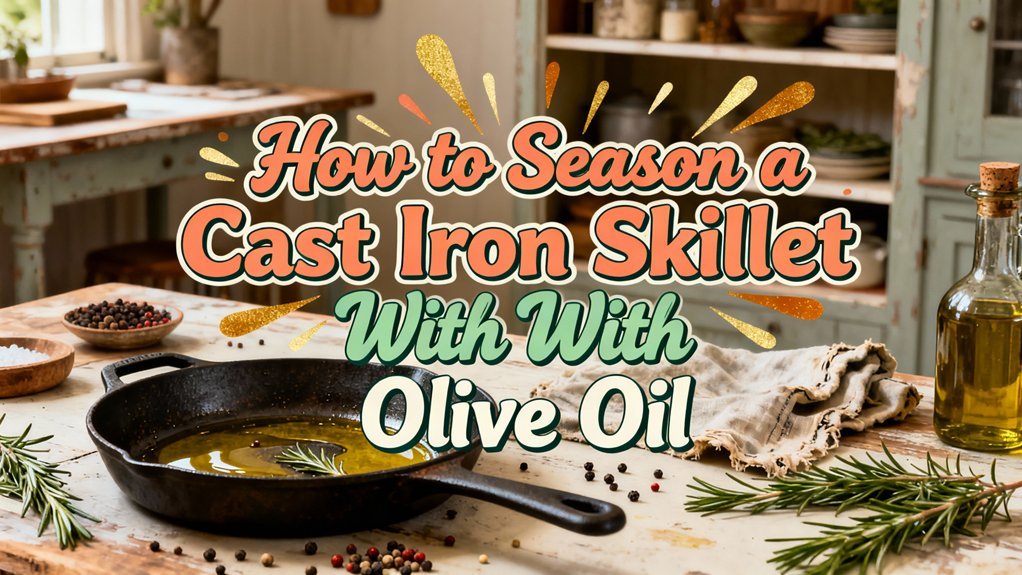
You’ll need refined olive oil—not extra-virgin—since it withstands temperatures up to 470–480°F without breaking down. After scrubbing your skillet clean and drying it thoroughly, apply a thin coat using a paper towel, then wipe away excess oil. Heat your oven to 450–500°F for one hour to trigger polymerization, creating a durable polymer layer. You’ll want to repeat this process three to six times for ideal results, and there’s much more to mastering cast iron seasoning.
Choosing the Right Olive Oil for High-Heat Seasoning
Why does olive oil selection matter for cast iron seasoning? You’ll want refined olive oil for cast iron seasoning because it withstands the high temperatures your skillet requires. Extra-virgin olive oil breaks down above 405°F, losing its flavor and nutrients while producing excessive smoke. Refined olive oil, conversely, remains stable up to 470-480°F, making it ideal for your seasoning process. High-heat olive oil varieties offer similar stability with enhanced antioxidants. When selecting your oil, prioritize reputable brands that verify smoke points and guarantee quality. Fresh Press Farms uses a unique cold pressing method on-site in Georgia to ensure maximum freshness and quality in their high-heat olive oil. Refined oils also contain monounsaturated fats that contribute to the oil’s stability at elevated temperatures. You should avoid extra-virgin entirely—its polyphenols and antioxidants degrade under high heat suitability conditions. Refined oils from ripe olives deliver consistent results without compromising your skillet’s seasoning layer or your kitchen’s air quality. While olive oil can work for seasoning, oils with higher smoke points like avocado oil and grapeseed oil may provide even more reliable results for maintaining cast iron cookware. The seasoning process creates a polymerized oil layer that bonds chemically with the iron when heated past the smoke point. Unlike olive oil, grapeseed oil offers a neutral flavor profile that won’t impart taste to your cookware or food. Multiple rounds of oiling and baking will build up a durable seasoning layer that improves with regular use and care. Proper seasoning technique—applying thin layers and heating the pan past the oil’s smoke point—matters significantly for developing a durable polymerized coating.
Preparing Your Cast Iron Skillet
Now that you’ve selected your refined olive oil, you’ll need to prepare your skillet’s surface to accept the seasoning layer properly. Begin surface preparation by scrubbing away food residue with coarse salt and a stiff brush. For rust removal, use steel wool on light rust until bare iron appears, then rinse and dry thoroughly. Heavy rust may require electrolysis or professional restoration methods. After cleaning, warm your skillet on the stovetop to evaporate all moisture—retained water promotes flash rust that undermines seasoning. Wipe the interior, exterior, and underside with a lint-free cloth and degreaser to remove oils and particulates. Remove any manufacturing stickers or adhesive residues completely. Inspect under good light for sticky spots or pooling, repeating your wipe until the surface appears uniformly thin and non-glossy. The coarse texture of kosher salt acts as a gentle abrasive for removing stubborn debris before seasoning. For optimal results, heat your skillet on a gas burner before applying your oil to ensure complete moisture evaporation. You can also use a chain mail scrubber in a circular motion with light pressure to dislodge stubborn residue while preserving any existing seasoning. Once your skillet is clean and dry, apply multiple rounds of seasoning oil to build up a durable protective layer that will improve with regular use. This layering process creates polymerization of oils, which hardens into a resilient, non-stick surface that strengthens over time. Thorough preparation ensures that cooking frequently with cast iron will maintain and strengthen your seasoning layer over time.
Applying a Thin, Even Coat of Oil
The success of your seasoning hinges on applying just enough oil—between one teaspoon and one tablespoon—to coat your entire skillet without creating pooling or sticky residue. Pour your refined olive oil directly into the skillet, then use a paper towel to spread it across all surfaces using circular motions. This methodical approach guarantees achieving uniform coverage on the interior, handle, and exterior simultaneously. Wipe away excess oil until you’ve achieved a non-dripping sheen—this light coating mimics factory seasoning spray processes and prevents smoking during baking. Your oil application techniques matter significantly here: too much oil causes uneven seasoning and requires re-seasoning cycles, while insufficient wiping leaves puddles that burn rather than polymerize. To prevent spots, blotches, and streaking on your newly seasoned iron, ensure you wipe away all excess oil with thorough attention to detail, similar to how proper placement of tools ensures accuracy in other cooking applications. The thin film fills microscopic pores effectively, creating a durable non-stick barrier. Refined olive oil works well for this process because it has a smoke point of 410-430°F, making it suitable for oven seasoning temperatures around 450°F. Unlike fats with lower smoke points, olive oil’s higher temperature threshold allows it to polymerize into a hard, non-stick surface more reliably during the baking process. For extended storage after seasoning, coat your skillet with oil and cover it to prevent dust accumulation. Building and preserving your skillet’s seasoning through regular use and proper maintenance ensures long-lasting performance and an increasingly effective non-stick surface over time.
Heating and Polymerization Process
Once you’ve applied your thin oil coat, you’ll need to heat your skillet to trigger polymerization—the chemical process that transforms liquid oil into a hard, durable polymer film. Set your oven to 450–500°F (230–260°C), which reliably activates free radicals in olive oil’s fatty acids. Heat for approximately one hour; don’t rush this stage, as polymerization kinetics require sustained temperature to build polymer chains effectively. However, avoid exceeding 550°F, where thermal degradation burns the nascent layer into brittle flakes rather than a resilient coating. After heating, cool your skillet inside the closed oven to allow slow curing and ideal adhesion to the iron substrate. Just as parchment paper can prevent sticking and burning in high-heat cooking applications, proper seasoning creates a non-stick surface that protects your cast iron. Multiple cycles—typically three to eight—create thicker, harder seasoning than a single bake. For optimal results, aim for at least six coats to build a robust seasoning layer that resists wear and maintains its non-stick properties. Smoking may occur during this process, indicating effective polymerization and confirming that the oil is bonding properly to the cast iron surface.
Building Durable Layers Through Repetition
After your skillet emerges from that initial polymerization cycle, you’ll find that one baked layer, while protective, won’t deliver the hardness and resilience that comes from intentional repetition. Build durability through successive seasoning cycles—aim for 3–6 thin coats during your initial setup phase. Apply 1–2 maintenance coats after heavy use or restoration to reinforce layer integrity. Concentrate layering sessions monthly during the first few months to accelerate surface maturation. Between each coat, inspect for visual sheen and tactile smoothness; sticky spots indicate over-application requiring removal and rebaking. Shorter, repeated heating cycles prove more effective than single prolonged bakes, as they create consistent polymer layers without irregular carbonization. For optimal results, use oils with a high smoke point such as vegetable or canola oil to ensure proper polymerization during heating. Cooling between cycles promotes gradual curing and prevents thermal shock that causes flaking. To prevent rust and maintain your seasoning investment, ensure your skillet is thoroughly dried after each use, especially around the rim and handle. Avoid soaking your skillet to prevent moisture damage to the seasoning layers. Regular cooking with fats and oils helps maintain the seasoning you’ve built and contributes to the rich culinary legacy that cast iron cookware passes through generations.
Maintenance and Long-Term Care
Your cast iron’s seasoning isn’t static—it requires consistent attention to preserve the polymerized layers you’ve built and prevent deterioration from use, moisture, and oxidation. Regular use with fats like bacon and oil reinforces your seasoning naturally, strengthening protective layers through routine cooking rather than relying solely on dedicated seasoning sessions. Between uses, store your skillet dry in a cool environment and apply a thin oil layer before storage to limit air and moisture exposure that causes rust. For optimal results, consider using Lodge Seasoning Spray Oil to maintain consistent seasoning between cooking sessions. Periodically inspect the interior, edges, and underside for thin spots or uneven buildup. Rotate pan usage and monitor seasoning development. Avoid prolonged acidic cooking when seasoning is thin, as acids strip protective layers. After cooking, always wash your skillet with warm water, dry it thoroughly, and give it a light coat of oil to maintain its seasoning and prevent rust. The perforated design of specialized grill pans with holes can affect how oils distribute during seasoning, so adjust your maintenance approach based on your specific cookware style. When storing your cast iron long-term, place the pan in a warm oven to allow it to cool together with the oven, which ensures longevity of your seasoning and overall condition. Avoid prolonged soaking that can rust unfinished rims and compromise your seasoning work. Unlike the quick-cooking benefits of cast iron, cookware like a Dutch oven’s slow-cooking benefits can also be maintained through proper storage and care techniques. For severely damaged or heavily encrusted pans, lye-based oven cleaner can strip away buildup before re-seasoning, though this method requires careful handling and safety precautions. These storage techniques and consistent cooking practices maintain long-term cast iron integrity.