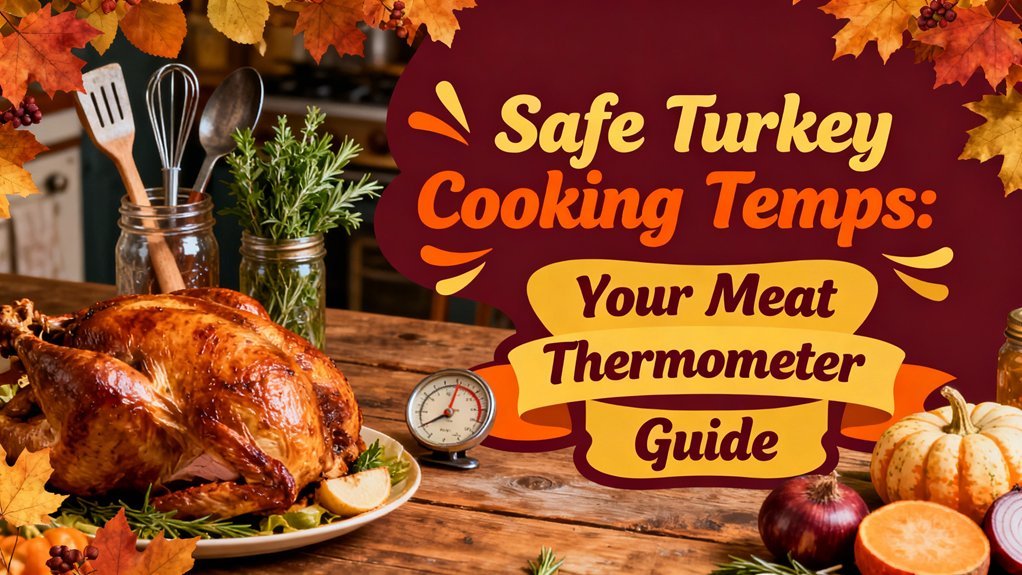
You’ll reach safe turkey by inserting your calibrated meat thermometer into three critical spots: the innermost thigh, innermost wing, and thickest breast. Each location must hit 165°F to eliminate harmful pathogens. Don’t rely on color or cooking time—only an accurate thermometer confirms safety. Account for carryover cooking, which raises temperature 5–10°F after removal. Proper placement and stabilization guarantee consistent readings. Understanding thermometer calibration techniques and advanced cooking methods further optimizes your results.
Understanding USDA Temperature Guidelines for Turkey Safety
Whether you’re roasting a whole bird or cooking turkey pieces, you’ll need to reach a minimum internal temperature of 165°F to confirm the meat’s safe for consumption. The USDA bases this standard on pathogen inactivation targets for Salmonella and other bacteria commonly found in poultry. During turkey prep, you’ll verify safety by checking three locations: the innermost thigh, innermost wing, and thickest breast. This multi-point verification guarantees uniform heating throughout. Ground turkey also requires 165°F because grinding increases pathogen risk. Don’t rely on color or cooking time alone—use a calibrated food thermometer for definitive results. When inserting your thermometer, place the tip into the thickest part of the meat, avoiding bones and fat, to ensure you’re reading the thermal center accurately. The USDA explicitly warns against oven temperatures below 325°F, as lower settings keep poultry in the bacterial danger zone too long, compromising food safety. After cooking, do not place cooked turkey on a plate that held raw meat without washing it first to prevent cross-contamination. For optimal results balancing safety and moisture retention, professionals often recommend removing the turkey at 150°F to allow carry over cooking to bring the thigh to 165°F while keeping breast meat more tender. Like cast iron skillets that require preheating to ensure even heat distribution, proper oven preparation helps achieve consistent turkey cooking throughout. Proper thermometer calibration ensures your readings remain accurate throughout the cooking season. Oven-safe probe thermometers are specifically designed to remain in the meat throughout the cooking process, providing continuous temperature monitoring for hands-off cooking convenience. Consider investing in a thermometer with wireless range capabilities to monitor your turkey’s temperature from a distance without opening the oven door repeatedly.
The Science Behind 165°F: Why This Temperature Matters
You benefit from heat safety margins built into this benchmark. The USDA prioritizes this specific threshold because it surpasses minimal lethality requirements, creating a buffer that protects you even if your thermometer reads slightly lower in certain spots. Additionally, carryover cooking adds 5-10°F after you remove the bird from your oven, further ensuring complete pathogen elimination. Understanding the science of pasteurization helps explain why this temperature works so effectively across different parts of the turkey. At 165°F, bacteria die almost instantly, making this threshold a reliable safeguard against foodborne illness. Just as even heat distribution is critical in cooking techniques, maintaining consistent temperature throughout your turkey ensures uniform safety across all sections. Proper storage planning, such as using vacuum sealing for meal prep, can help you organize ingredients efficiently before cooking day. For longer cooking times, you may want to consider space-saving storage solutions for your meal prep ingredients before cooking day. For the most reliable results, consider using a leave-in probe thermometer that allows you to monitor temperature continuously throughout the cooking process. Proper thermometer placement in the thickest part of the thigh provides the most accurate readings to verify your turkey has reached the safe temperature.
This single-temperature standard works universally—breast, thigh, and stuffing all require 165°F verification.
Advanced Cooking: Lower Temperature Options for Experienced Cooks
Once you’ve mastered standard roasting techniques, low-temperature methods offer a pathway to superior moisture retention and precise control over the final product. You’ll begin at 400-450°F for one hour, then drop to 170-250°F for the remainder of cooking. This two-phase approach prevents the danger zone while developing skin color.
Advanced basting with buttermilk brine enhances moisture during the low-temperature phase. You’ll monitor internal temperatures with a Bluetooth thermometer, targeting 160°F in the breast before adjusting to 170°F. Digital probe thermometers offer faster and more accurate measurements compared to traditional analog models, ensuring you achieve the precise internal temperatures required for safe consumption. Tent with foil if browning occurs too quickly. Remember to baste every thirty minutes to maintain consistent moisture levels throughout the cooking process. Allow the turkey to rest for 40 minutes after cooking to retain the juices you’ve worked to preserve.
Low temperature techniques require experience and vigilance. Smaller to medium birds work best, reaching 165°F safely within your timeline. Foil-covered pans with vegetables underneath capture drippings while maintaining even heat distribution throughout cooking, similar to how cast iron skillets provide superior temperature consistency for searing applications.
How to Use a Meat Thermometer Correctly
Because accurate temperature readings determine whether your turkey’s safe to eat, proper thermometer technique is essential. Start with thermometer placement by inserting the probe into the thickest part of the thigh, avoiding bone contact entirely. Push the probe to the deepest section without touching the pan or sides. Allow a few seconds for the reading to stabilize.
Before cooking, perform calibration checks using an ice water bath. Fill a tall glass with ice and cold water, then hold your thermometer in it for 30 seconds without touching the sides or bottom. The reading should register 32°F. For dial thermometers, adjust the gauge nut with pliers if needed. Digital models require you to add or subtract any inaccuracy from your target temperature. Cleaning your thermometer between different meat types prevents cross-contamination and ensures accurate readings across various proteins. Remember that carryover cooking will continue to raise the internal temperature slightly after you remove the turkey from heat. Like vacuum sealing for long-term storage, proper thermometer maintenance helps preserve food quality and safety. Just as glass requires gradual cooling to prevent cracking after heating, turkey must rest after cooking to allow internal temperatures to stabilize evenly. Different types of meat thermometers, including instant-read digital thermometers, each offer distinct advantages depending on your cooking method. Investing in a quality instant read thermometer ensures both food safety and precise doneness for your holiday meal. Using the correct thermometer type for your cooking method, such as oven-safe programmable thermometers for turkey roasting, guarantees continuous monitoring without repeatedly opening the oven door.
Oven Roasting: Temperature Settings and Timing
Three distinct temperature stages—275°F, 350°F, and 325°F—form the foundation of successful turkey roasting, with the specific approach depending on your bird’s size and your preferred browning technique. You’ll start at 275°F during the initial low-and-slow stage, covering your turkey with heavy aluminum foil and calculating 10 minutes per pound. Next, you’ll remove the foil, increase heat to 350°F, and apply your butter mixture using consistent basting methods every 30 minutes. For turkey sizes between 6-20 pounds, you’re targeting 2¼ to 4½ hours total at 325°F. You’ll tent the breast with loose foil once golden, then reveal during the final hour for ideal skin browning. After reaching your doneness indicators—165°F to 170°F in both thigh and breast—allow a 10-minute resting period before carving. No water should be added to the roasting pan, as the turkey’s natural juices provide excellent basting liquid and help develop deeper flavor. Covering your turkey initially helps retain moisture, which is particularly beneficial during the lower temperature cooking phase. Using a meat thermometer to check the innermost part of the thigh and the thickest part of the breast ensures you accurately verify that all areas have reached the safe temperature. To achieve consistent accuracy, remember to calibrate your thermometer regularly before use. Much like the seasoning process for cast iron skillets, where multiple rounds of oiling and baking build a durable, long-lasting surface, turkey roasting success develops through repeated applications of technique. Just as proper seasoning technique matters more than the specific oil chosen when preparing cast iron, successful turkey roasting depends on consistent basting methods and careful temperature management rather than complex preparation steps. Like the simple approach to baking desserts, turkey roasting success relies on minimal ingredients and careful timing to achieve optimal results.
Smoking and Grilling Your Turkey Safely
While oven roasting relies on steady, enclosed heat, smoking and grilling demand active temperature management and vigilant monitoring to safely cook your turkey through while preserving moisture and developing distinctive flavor. You’ll typically set your grill setup between 225–250°F for low-and-slow smoking techniques, expecting roughly 30–40 minutes per pound. At these temperatures, carryover cooking is minimal, so plan accordingly. You should pull your breast at 160°F (it’ll rise slightly during rest) and allow thighs to reach 170–175°F. Deploy leave-in probes in both breast and thigh to avoid frequent smoker openings. Verify probe placement in the thickest portions, avoiding bone contact. Calibrate your thermometer beforehand and check multiple locations to confirm doneness and guarantee food safety. Just as proper heat management is essential in precision cooking, maintaining neutral heat distribution across your smoker prevents hot spots that could unevenly cook your turkey. Searing your turkey over direct heat before transitioning to indirect smoking can develop a flavorful crust similar to techniques used in Dutch oven cooking. Before smoking begins, preheat your pellet grill to 225°F with the lid closed for 15 minutes to establish consistent cooking conditions. Quality wireless thermometers with temperature alert systems notify you immediately when your turkey reaches target doneness, allowing you to multitask without constantly checking your smoker. Consider using a Smoke X4 receiver to continuously track both turkey temperature and smoker conditions throughout the cooking process for enhanced monitoring precision.
The Importance of Resting and Carryover Cooking
Once you’ve pulled your turkey from the heat source, the cooking process doesn’t immediately stop—carryover cooking continues to raise the internal temperature, sometimes by as much as 5–10°F depending on the bird’s size and your cooking method. This phenomenon requires strategic resting duration planning.
You’ll want to remove your turkey when the breast reaches 157°F, accounting for carryover cooking to reach the USDA-mandated 165°F safe minimum. Allow 20-30 minutes for resting, during which you’ll loosely tent the bird with foil to preserve crisp skin while juices redistribute throughout the meat. Using a meat thermometer ensures you accurately verify doneness rather than relying on timing estimates alone. For optimal results, rest your turkey for at least 1 hour after cooking to achieve maximum juiciness and tenderness. A heat-resistant probe thermometer allows you to monitor temperature progression throughout the resting period without repeatedly opening the oven or handling the hot bird. Understanding the distance-to-spot ratio of your thermometer helps ensure accurate readings when measuring your turkey’s surface temperature from various distances. Cast iron cookware with a tight-fitting lid can also be used to maintain heat and moisture around your resting turkey, keeping it warm while protecting the skin from drying out during the critical resting phase. For extended resting periods, consider using vacuum sealer bags to create an insulated chamber that retains heat and preserves moisture around your turkey.
This resting duration yields considerably juicier, more tender results through proper heat distribution and retention that continues to equalize throughout the meat. You’ll also achieve reliable cooking times and minimize shrinkage. Verify both breast and thigh hit 165°F post-rest before carving and serving.
Cooking Stuffed Turkey: Special Safety Considerations
Now that you’ve mastered timing your turkey’s removal and resting period, you’ll need to address a more complex safety challenge if you’re cooking with stuffing inside the bird. Stuffing safety demands rigorous temperature verification because the cavity’s insulation prevents heat from penetrating as quickly as the surrounding meat. You must insert thermal sensors directly into the stuffing’s geometric center—not touching bone—to confirm it reaches 165°F, independent of thigh or breast temperatures. Pop-up indicators won’t suffice here. Pack your stuffing loosely to facilitate heat circulation, and expect cooking times to extend 15–30 minutes beyond unstuffed guidelines. Just as a cast iron skillet requires proper heat management to achieve even cooking results, your stuffing needs consistent temperature monitoring throughout the roasting process. Proper storage and maintenance of your cooking equipment, including regular maintenance of your roasting pan, helps ensure reliable performance throughout the cooking process. To prevent bacteria risks, avoid buying pre-stuffed turkeys and instead prepare your own stuffing to monitor food safety throughout the cooking process. Once your stuffing is cooked, store any leftovers in an airtight container in the refrigerator and consume within 1–2 days to maintain freshness and safety. If your stuffing hasn’t reached 165°F when the turkey finishes cooking, either continue roasting or transfer the stuffing to a separate dish to finish cooking safely.
Thawing Your Turkey Without Compromising Food Safety
Before you can cook your turkey safely, you’ll need to thaw it properly—and this step’s just as critical as monitoring internal temperatures. You’ve got two reliable options: refrigerator thawing and cold water thawing.
Refrigerator thawing’s the safest method, requiring 24 hours per 4-5 pounds. A 16-pound turkey needs roughly four days at 40°F or below. Place your turkey breast-side-up in a pan to catch juices and prevent cross-contamination.
Cold water thawing works faster, allowing 30 minutes per pound. Submerge your wrapped turkey in cold tap water, changing the water every 30 minutes. A 16-pound bird thaws in 6-8 hours. Allow your thawed turkey to rest and stabilize for a few minutes before beginning your cooking process.
Never thaw on countertops, porches, or in warm water—these methods push your turkey into the bacterial danger zone. Once thawed through either approved method, you’ll have 1-2 days before cooking. Proper meat thermometer calibration relies on fixed physical reference points like the freezing or boiling point of water to ensure accurate temperature readings. For long-term accuracy and reliability, consider seasoning your thermometer probe periodically to maintain its precision. Keep a clear line of sight to your turkey’s thickest parts when measuring temperature with your thermometer. Consider using a cast-iron Dutch oven for slow-roasting your thawed turkey to ensure even heat distribution and optimal moisture retention.
Storing and Reheating Leftover Turkey Properly
Your turkey’s safety doesn’t end when you’ve finished cooking—proper storage and reheating are equally critical to prevent foodborne illness. For leftover storage, refrigerate turkey within two hours of cooking at 40°F or below. Use shallow containers to cool meat quickly, and consume within three to four days. Gravy requires faster use—discard after two days. Storing your leftovers in shallow containers helps the meat cool quickly and evenly, similar to how simmering in a Dutch oven distributes heat throughout a dish.
When freezing, remove meat from bones and slice before packaging in airtight containers to preserve quality for up to six months. Label everything with contents and dates. Consider using vacuum sealing for even longer preservation and to prevent freezer burn on your frozen turkey portions.
For reheating techniques, warm turkey, stuffing, and gravy to 165°F internally using a calibrated food thermometer. Stir liquids, cover dishes, and allow standing time for even temperature distribution throughout all portions.