
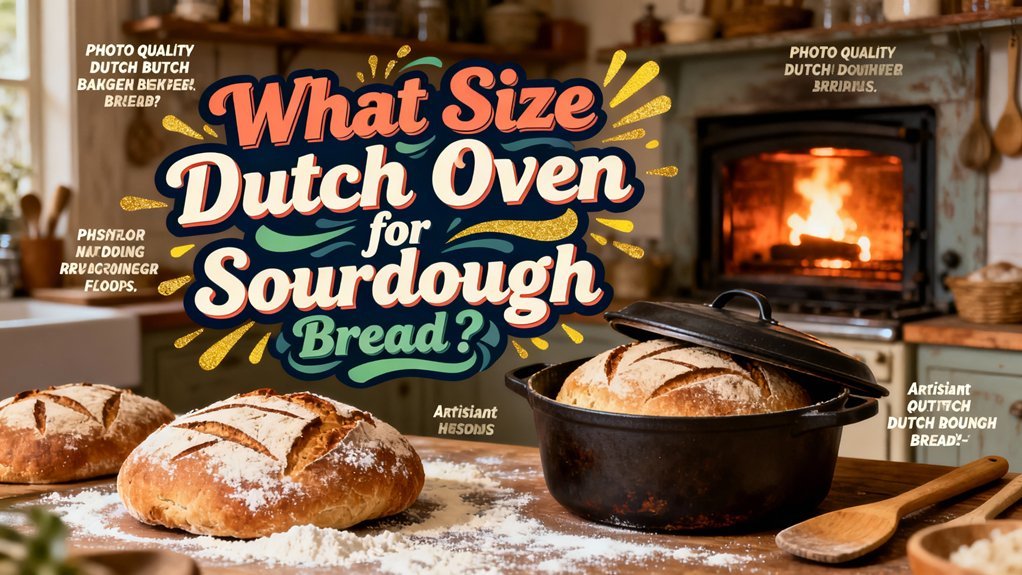
You’ll want a 5-quart round cast-iron Dutch oven for most home sourdough loaves. Its 10-inch diameter and 4-5 inch depth create the ideal balance between steam retention and proper oven spring without excessive spreading. This size accommodates 600g boules perfectly while maintaining 2-3cm headroom above your shaped dough. For elongated batards or larger 1kg loaves, you’d consider 5-7 quart oval vessels instead. The specifics of pot dimensions—wall thickness, lid tightness, and interior clearance—significantly impact your final crust character and loaf height.
The Best All-Purpose Dutch Oven Size for Home Sourdough
When you’re baking sourdough at home, you’ll want a 5-quart round cast-iron Dutch oven as your go-to choice. This size accommodates 600g loaves while providing adequate space for proper rise without restriction. You’ll find the 10-inch diameter interior prevents excessive spreading, and the 4 to 5-inch depth allows upward expansion during baking.
The 5-quart capacity suits versatile baking across different bread styles and recipes. You can experiment with boules and batards using identical dough batches, confident you’ll achieve consistent crust and taste results. The enamel finish protects your cast-iron investment while maintaining high-heat performance up to 500°F. A tight-fitting lid effectively retains heat and steam throughout the baking process, which is essential for developing that superior oven spring and crispy crust. Cast-iron’s exceptional heat retention and even distribution creates the ideal environment for sourdough browning and crust development. Both cast-iron and ceramic Dutch ovens perform excellently for sourdough baking, though cast-iron offers greater versatility for daily cooking tasks.
For loaf experimentation, preheating to 500°F for 20 minutes optimizes results. Just as proper internal temperature measurement ensures food safety in other cooking applications, monitoring your Dutch oven’s preheating ensures optimal baking conditions for sourdough. Storing your finished sourdough requires proper food preservation techniques to maintain quality and extend shelf life. This all-purpose size handles daily bread production, making it ideal for home bakers seeking reliability and consistent performance.
Matching Pot Size to Your Dough Weight and Loaf Shape
While the 5-quart Dutch oven works well for standard home batches, you’ll achieve better results by aligning your pot dimensions directly to your specific dough weight and desired loaf shape. Match your pot shape to your loaf form: round boules fit 4–5 L pots, while oval Dutch ovens better accommodate 500 g–flour batards. Calculate volume ratios by doubling your shaped dough volume to account for dough expansion and oven spring. For a 500 g flour recipe yielding ~900–1,000 g dough, a 6–7 L pot provides adequate clearance space. Maintain 2–3 cm headroom above shaped dough to prevent lid contact during rise. Dough can rise directly in the Dutch oven before baking, which simplifies your workflow and reduces cleanup. An infrared thermometer can help verify your Dutch oven has reached the proper preheating temperature for optimal bake results. Scale recipes proportionally if your available pot volume’s smaller—use ~60% of standard recipes for 3 qt vessels. Preheating an empty Dutch oven risks thermal shock, though this risk is minimal when placing dough in a preheated oven. These adjustments optimize baking performance and oven safety.
How Dutch Oven Dimensions Affect Oven Spring, Crust, and Loaf Height
Your Dutch oven’s physical dimensions—wall thickness, internal diameter, depth, and lid design—directly shape how your sourdough develops oven spring, crust character, and final loaf height. Thicker cast-iron walls retain heat longer, maintaining stable temperatures during the critical steam phase and promoting stronger oven spring. A smaller internal diameter relative to your dough’s width forces upward expansion, creating taller loaves with better rise. Conversely, wide, shallow pots encourage lateral spreading and flatter profiles. Greater vertical clearance prevents your loaf from hitting the lid prematurely, allowing unimpeded upward growth. A tight, heavy lid maximizes steam retention, concentrating moisture that delays crust set and supports dramatic oven spring and blistering. The trapped steam during this initial baking phase is essential for developing that signature crispy, golden crust while keeping your crumb structure open and airy. Like a Dutch oven used for cooking ham, your bread’s Dutch oven benefits from heat retention during cooking to achieve optimal results. The combination of apples, onions, and cider used in savory braised dishes demonstrates how Dutch ovens excel at capturing and circulating aromatic flavors through sustained heat retention. When handling your Dutch oven during and after baking, observe safety precautions for extremely hot cookware to avoid burns and injuries. Preheating the Dutch oven is not strictly necessary but can further enhance crust development and oven spring intensity. Consider using an enameled cast iron Dutch oven as an alternative to bare cast iron, which offers easier maintenance while still providing excellent heat retention and steam trapping capabilities. Optimal sizing between 4.5 to 5.5 quarts with an inside diameter of 8.5 to 9.5 inches ensures your dough weight of 600 to 900 grams develops evenly without constraint. Your oven shape and steam retention work together to determine final loaf architecture and crust quality.
Sizing Guidelines for Different Loaf Types and Batch Quantities
Now that you understand how Dutch oven dimensions influence oven spring and crust development, you’ll want to match those physical characteristics to your specific dough size and loaf style. For standard 500g boules, you’ll need a 5-quart round Dutch oven. If you’re experimenting with oval batards, opt for a 5-7 quart oval vessel to accommodate the elongated loaf shaping. When scaling down, a 3-quart combo cooker handles reduced batches with 3.5 cups flour using adjusted baking techniques. For larger loaves exceeding 1kg, you’ll benefit from a 6-quart Dutch oven or double Dutch setup, which produces wider, shorter shapes. The thick walls of your Dutch oven store and radiate heat to ensure even rising throughout the baking process. A 6-quart Dutch oven is ideal for steam retention, which is essential for developing that beautiful golden crust and perfect ear. Once your sourdough is baked, consider using vacuum sealing techniques to preserve your finished loaves and extend their shelf life. Your Dutch oven selection directly impacts how effectively your baking techniques translate across different loaf types, making proper sizing essential for consistent results.
Practical Dimensions and Recipe Matching Strategies
Three key measurements—interior diameter, depth, and total volume—determine whether your Dutch oven’ll accommodate your dough and deliver the oven spring you’re after. Start by measuring your shaped dough’s volume using a container; it should occupy 50–60% of your pot’s interior space maximum.
For dimensions comparisons, match flour weight to pot capacity: 500 g flour requires 4–5 qt/ℓ round pots (9–11 in diameter, 4–5 in depth), while 750 g demands 6–7 qt/ℓ vessels. Capacity considerations mean larger pots allow lateral expansion and wider loaves, whereas snug pots promote taller loaves with stronger vertical spring. The heavy pot ensures even heat distribution throughout the baking process, which is essential for consistent crust development.
Adjust baking times accordingly; larger pots may need extra minutes for even crust development. Prioritize depth ≥4 in to prevent flattening during initial steam phases. After baking, allow your Dutch oven to cool completely and apply a thin layer of oil to prevent rust before storing.
Essential Functional Considerations for Dutch Oven Selection
Beyond matching pot size to dough weight, you’ll need to contemplate how your Dutch oven’s thermal properties, steam management, and interior geometry interact to shape your final loaf. Smaller pots concentrate radiant heat, accelerating crust formation—ideal for standard baking techniques targeting crispy exteriors. Conversely, larger vessels moderate temperature swings, potentially lengthening bake times. Your lid’s seal quality matters critically; a tight fit traps steam regardless of pot size, directly influencing oven spring and crust development. Consider dough hydration when selecting geometry: wetter doughs benefit from slightly larger pots to prevent boil-over during aggressive expansion. For optimal food preservation results during extended storage, ensure your Dutch oven maintains temperature resistance comparable to specialized food storage containers. Restricted lateral space encourages vertical rise and tighter crumb structure, while expanded floor area permits lateral spread and more open crumb. Match your pot’s interior volume and depth to your intended loaf shape for predictable, repeatable results. The ideal Dutch oven size operates in the Goldilocks Zone, where the vessel complements your baking goals without causing dense texture from restriction or excessive spread from excess space.
Material, Handles, and Heat Safety for High-Temperature Baking
While optimizing your pot’s geometry and steam management sets the foundation for excellent sourdough, you’ll also need to verify that your Dutch oven’s material properties and handle durability can withstand the high temperatures your recipe demands.
Cast-iron Dutch ovens excel for sourdough, handling 500°F preheats without restriction. Enameled variants max out around 450°F—check your manual. Critically, inspect handles and knobs; plastic components fail at 390-480°F, risking failure during high-heat baking. Cast-iron handles remain fully oven-safe, while enameled handles typically match their pot’s heat tolerance. Dutch ovens are versatile cookware suitable for both stovetop and oven use across diverse cooking applications, from bread baking to camping desserts like cobblers and cakes. The tight-fitting lid locks in moisture and flavor during the baking process, creating the steam environment essential for proper crust development. When selecting your Dutch oven, consider lid fit and handle design as these features directly impact your baking success and safety at elevated temperatures.
Avoid plastic hardware entirely for sourdough work. To maintain your cast-iron Dutch oven’s longevity, regular cooking with oil further develops and strengthens the seasoning layer, creating a natural non-stick surface that improves with use and care. Preheat gradually to prevent thermal shock and cracking. Always add liquid or oil before heating enameled surfaces. Use thick oven mitts when handling your Dutch oven after removal from the oven, as it retains extreme heat even after cooking completes. Position your Dutch oven on the middle rack, never the floor, ensuring even heat distribution and protecting the base from direct heat stress.
Testing and Comparing Different Dutch Oven Sizes for Your Recipes
How do you know which Dutch oven size actually works for your sourdough? The best approach is conducting sourdough experiments with your standard 500 g flour recipe across different pot volumes. Start with a 4–5 quart round pot—the most forgiving baseline—then test a 6–7 quart oval if you bake batards frequently. Document your results: measure oven spring height, observe lateral spread, and evaluate crust color and crumb structure. Size versatility emerges when you note how dough behaves in each pot. A tighter pot yields taller spring; a larger one permits wider expansion. Compare baking times and internal temperature curves between sizes. Quality enamel coating on your Dutch oven will also affect heat distribution and browning characteristics during the baking process. These direct trials reveal which pot matches your preferred loaf dimensions, scoring response, and crumb openness, eliminating guesswork from your equipment choice. Proper portioning and storage techniques like vacuum sealing can also help preserve your finished loaves and maintain their quality throughout the week. For additional insight into Dutch oven cooking techniques, consider how deglazing the pot with liquid helps develop deeper flavors in your baking process.