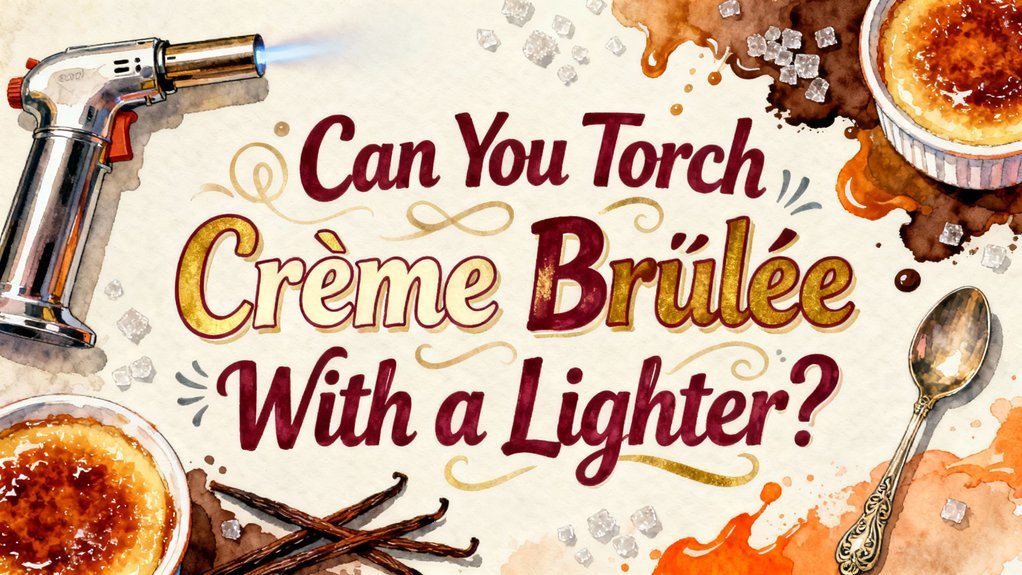
You can’t reliably torch crème brûlée with a conventional lighter. While lighter flames reach 1,975°F at the tip, they don’t sustain the concentrated 356-374°F heat needed for proper sugar caramelization without burning your custard. Lighters lack the precision, adjustability, and duration that kitchen torches provide. You’ll struggle to achieve even browning and risk irreversible burning above 390°F. Understanding why this matters reveals what separates amateur attempts from professional results.
Why Kitchen Torches Are the Standard Tool for Crème Brûlée
When you’re caramelizing the sugar topping on crème brûlée, you’ll find that kitchen torches deliver the precision and control that lighters simply can’t match. Kitchen torch benefits include adjustable flame intensity, enabling you to maintain ideal distance—typically 2-3 inches from the dessert surface. This precision cooking approach guarantees consistent heat distribution across the sugar layer, creating an even caramelized crust without charring edges or melting the custard beneath. The caramelized sugar top creates a professional finish that transforms the dessert’s texture and appearance.
Professional chefs universally adopt culinary torches because their ergonomic design, built-in ignition systems, and flame guards facilitate safe, repeatable results. The focused heat application prevents unintended damage to your dessert. Specialized butane fuel burns at predictable temperatures, meeting food-safe standards while providing the sustained flame necessary for proper sugar crystallization. Moving the flame in slow, circular motions across the sugar ensures even caramelization and prevents burning or bitterness. Beyond desserts, kitchen torches are also effective for roasting peppers and tomatoes to easily remove their skins, expanding your culinary toolkit beyond sweet applications. Like cast iron skillets that maintain consistent heat retention qualities, kitchen torches provide reliable and predictable performance for precision cooking tasks. Similar to how candy making requires specialized high-temperature thermometers designed to withstand extreme heat and provide accurate readings, culinary torches are engineered specifically for controlled heat application in cooking tasks. For optimal results, allow your crème brûlée to cool completely before torching, as thermal shock from rapid temperature changes can compromise the dessert’s structure. Most cooking torch models are priced between $10 and $30, making them an affordable investment for home cooks seeking gourmet results. Restaurant kitchens and culinary training programs standardize kitchen torches for exactly these performance advantages.
Temperature Requirements for Proper Sugar Caramelization
Because sugar’s transformation into caramel depends entirely on precise heat management, you’ll need to understand the critical temperature thresholds that separate perfect caramelization from burnt failure. Sugar begins melting at 320°F (160°C), but ideal caramelization techniques occur between 340-356°F (170-180°C), producing that coveted deep golden color. For crème brûlée specifically, you’ll target 356-374°F (180-190°C) to achieve the desired deep brown crust. These temperature thresholds require focus—exceeding 390°F (200°C) risks irreversible burning. Meanwhile, your custard must stay below 100°C to prevent granular texture and egg yolk coagulation at 68°C. By refrigerating your custard beforehand and maintaining proper temperature thresholds during torching, you’ll achieve the textural contrast that defines exceptional crème brûlée. An instant read thermometer allows you to monitor both sugar and custard temperatures with precision, ensuring you hit your target heat ranges without guesswork. Just as searing meat requires very hot skillet temperatures to develop a properly caramelized crust, achieving the ideal brûlée surface demands sustained heat intensity. The Dutch oven’s superior heat retention and tight-fitting lid make it ideal for preparing custard bases that maintain consistent temperatures throughout cooking. When selecting your equipment, butane-powered culinary torches offer superior flame control capabilities compared to standard lighters. Traditional preparation methods recommend serving dishes in individual ramekins to ensure even heat distribution during caramelization. Moving the flame in a circular motion prevents hot spots and ensures even caramelization across the sugar surface. A blowtorch is essential for delivering the concentrated heat needed to reach these precise caramelization temperatures, as standard lighters cannot sustain the required intensity.
How Conventional Lighters Fall Short
Now that you understand the precise temperature window required for proper caramelization—specifically 356-374°F for crème brûlée‘s ideal crust—you’ll quickly reveal that conventional lighters simply can’t deliver the concentrated heat necessary to reach these thresholds.
Lighter limitations stem from fundamental design flaws. While butane lighters reach 1975°F at their tip, the core flame remains insufficient for sustained caramelization. Heat dissipates rapidly beyond the nozzle, failing to maintain the 338°F minimum needed for liquefaction. During caramelization, chemical reactions that change sugar’s color and flavor occur as the sugar undergoes transformation into brown molecules. To achieve proper results, a heavy gauge metal pot ensures even heating across the sugar surface, which a lighter cannot replicate. Just as one-pan dishes require consistent heat distribution for successful cooking, caramelization demands the same level of thermal control. Dedicated cooking torches with appropriate flame patterns are specifically designed to provide the concentrated, even heat distribution that lighters fundamentally lack. Similar to how seasoning cast iron requires multiple applications to build an effective cooking surface, proper caramelization necessitates sustained, controlled heat that lighter flames cannot maintain.
Your caramelization challenges multiply with diffuse, unfocused flames spreading heat unevenly across the sugar surface. This broad distribution prevents the rapid, localized heating required for proper browning. Just as seal integrity proves critical when preserving delicate flavors in other culinary applications, maintaining consistent heat distribution is essential for caramelization success. Proper heat control during cooking mirrors the principles used in freezer burn prevention where maintaining optimal conditions protects food quality. Instead, you’ll encounter inconsistent results—crystallization in weak zones and burning in concentrated spots—making lighters fundamentally unsuitable for achieving crème brûlée’s signature caramelized crust.
Safety Features Built Into Culinary Torches
Unlike conventional lighters that prioritize simplicity over safety, culinary torches incorporate multiple protective mechanisms designed to prevent accidents during high-heat cooking. You’ll find integrated safety locks that prevent accidental ignition when you’re not actively using the torch. Child proof features include dedicated locking systems that keep the device secure from unauthorized use.
The electronic ignition pairs seamlessly with safety lock engagement, ensuring you can’t accidentally trigger flame release. An automatic safety shut-off sensor activates if you hold the trigger too long, protecting you from overexposure to extreme heat. Additionally, a safety switch on the adjustable gas flow ring gives you precise control over fuel delivery. Proper usage techniques require working in well-ventilated areas to ensure safe operation during cooking. The aluminum alloy flame tube construction provides heat resistance for sustained culinary applications without degradation. Before using your torch, ensure you are using refined culinary butane fuel specifically formulated for cooking applications. Culinary torches feature flame control options that allow you to adjust intensity based on your specific cooking task. Like preheating an oven for cast iron skillet pizza, preparing your culinary torch properly ensures optimal results. Regular maintenance and equipment care will help prevent performance issues and extend the life of your culinary torch. These layered safety mechanisms work together to create reliable performance during cooking tasks. These layered safety mechanisms work together, allowing you to torch crème brûlée confidently and responsibly.
Flame Control and Adjustability Differences
When you’re torching crème brûlée, your success depends on mastering flame control—and that’s where culinary torches considerably outperform conventional lighters. Professional torches deliver precise flame adjustability through lever-marked valves that regulate butane flow toward plus or minus settings. You’ll achieve exact heat levels impossible with standard lighters.
Nozzle design variations further distinguish torches from basic lighters. Adjustable nozzles switch between focused or wide flames, fine-tuning intensity and size for your specific task. Finer tips suit precision caramelizing; larger burners produce broader heat distribution. Like cast iron skillets that distribute heat evenly for consistent cooking results, culinary torches benefit from superior heat distribution design. The combustion chamber in culinary torches mixes butane with air more efficiently than lighters, resulting in a more stable and controllable flame. For crème brûlée, you need temperatures in the low-end temperature range of approximately 1,300 to 1,400°C to properly caramelize the sugar without burning the custard beneath.
Culinary torches feature anti-flare technology and push-button ignition systems with continuous flame locks—eliminating the constant trigger pressure required by lighters. This enhanced adjustability guarantees consistent, controlled caramelization across your dessert’s surface.
Operating a Kitchen Torch Correctly
Mastering your kitchen torch requires understanding five essential operational components: refueling procedures, flame adjustment techniques, ignition and safety activation, application methods, and troubleshooting. You’ll start by positioning the adjustment pin at center between minus and plus signs before ignition. Press the safety button down, then engage the ignition button for reliable starts. For flame calibration, shift the pin toward minus for precision work or toward plus for aggressive searing. Hold your torch 2-4 inches from the target surface, moving it slowly in even motions. Torch maintenance involves cleaning the nozzle with compressed air if flame distribution becomes uneven. To ensure optimal performance, allow the torch to cool for 15 minutes before refueling to prevent damage to internal components. Both butane-powered handheld torches and propane models require careful attention to fuel selection and storage to maintain reliability. Most professional kitchen torches include built-in automatic ignition systems like Piezo ignition technology, which enable safe and convenient lighting without external assistance. After use, turn off the torch completely and engage the safety lock feature to guarantee proper equipment care. Always position the torch at the correct distance and angle to achieve delicate caramelization while preserving the integrity of your dish. Understanding safety mechanisms and proper handling techniques will help you work confidently with your torch across different culinary applications. Like vacuum sealing, successful torch work depends on using the right techniques to avoid compromising your results. Proper technique also helps you avoid common mistakes like over-browning or creating bitter flavors that can compromise your final dish.
The Limitations of Standard Lighter Heat Duration
Standard lighters fundamentally can’t sustain the continuous flame exposure you’ll need for proper crème brûlée caramelization. Their design prioritizes safety over sustained heat output. After you release the ignition button, standard lighters extinguish within two seconds, and any protected flame beneath a hood dissipates completely within another two seconds. Even BIC lighters, known for reliability, shut down in less than half a second. This flame duration severely limits your lighter efficiency for culinary torching. The adiabatic peak temperature of 4,074°F means little when you can’t maintain flame contact long enough to caramelize sugar properly. Skin can burn at temperatures as low as 109.4 degrees Fahrenheit, which underscores how quickly heat dissipates from brief lighter flames. Environmental heat dissipation further reduces actual temperatures below theoretical maximums, with wind affecting traditional lighter flame and cooling down the already brief heat output. You’ll experience interrupted heating cycles, uneven caramelization, and frustrating restarts—making a dedicated kitchen torch essential for consistent results.
Beyond Crème Brûlée: Other Kitchen Torch Applications
While crème brûlée represents the most recognizable kitchen torch application, you’ll find that dedicated culinary torches open up substantially broader cooking capabilities across proteins, vegetables, and specialty techniques. You can sear fish for tataki dishes, creating contrasting raw interiors with caramelized crusts through controlled Maillard reactions. Your torch techniques extend to smoking meats with smoldering herbs like sage and rosemary, infusing complex flavors without outdoor equipment. You’ll rapidly blister pepper skins for efficient peeling, char corn kernels for salsa, and toast breadcrumbs to golden perfection. These middle-range models are easy to handle while performing these diverse tasks. Your culinary creativity flourishes when recreating wok hei effects on stir-fry ingredients or preparing brûléed grapefruit with cayenne and brown sugar. These applications demonstrate how focused heat transforms fundamental cooking processes, much like how sustainable sous vide alternatives maintain cooking performance while reducing environmental impact. Proper technique requires maintaining steady heat application and rotating ingredients to prevent uneven cooking, similar to annealing practices that ensure structural integrity, and avoiding rapid temperature changes that can damage cookware. A torch also lets you brown meringue on desserts like lemon meringue pie, adding visual contrast while partially cooking the outer layer for enhanced stability and smoky flavor.
Investing in the Right Equipment for Dessert Preparation
Your culinary torch applications demand equipment specifically engineered for consistent, high-performance dessert finishing. You’ll find that commercial-grade torches deliver superior temperature precision—exceeding 2,000 degrees Fahrenheit—enabling even caramelization impossible with standard lighters.
When you invest in purpose-built culinary equipment, you’re securing equipment longevity that withstands high-volume service demands. Refillable butane systems operate efficiently for three hours of continuous use, reducing per-unit costs considerably compared to lighter fuel consumption. Similar to how induction-compatible cookware requires specific magnetic properties, culinary torches demand ferrous metal construction for optimal performance. Trusted brands like Hollowick and Whip-It! have established strong reputations in the industry for their reliable torch performance.
You’ll appreciate user-friendly design features like adjustable flame controls and ergonomic grips that minimize hand fatigue during extended preparation sessions. Push-button ignition systems provide quick starts and hands-free operation. Anti-flare technology guarantees kitchen safety while maintaining consistent heat output. Just as preheating equipment with consistent internal temperature ensures optimal cooking results, torches with stable heat output deliver reliable caramelization. The RW Pyro Collection models generate flames reaching up to 2370°F, making them ideal for powerful cooking tasks and professional dessert preparation. For those seeking faster preparation methods similar to achieving crispy crusts efficiently, proper torching technique ensures you achieve that signature crispy, golden-brown sugar crust without burning the delicate custard beneath.
Professional-grade torches represent an essential investment in operational efficiency, food quality, and customer satisfaction—directly impacting your revenue generation potential.