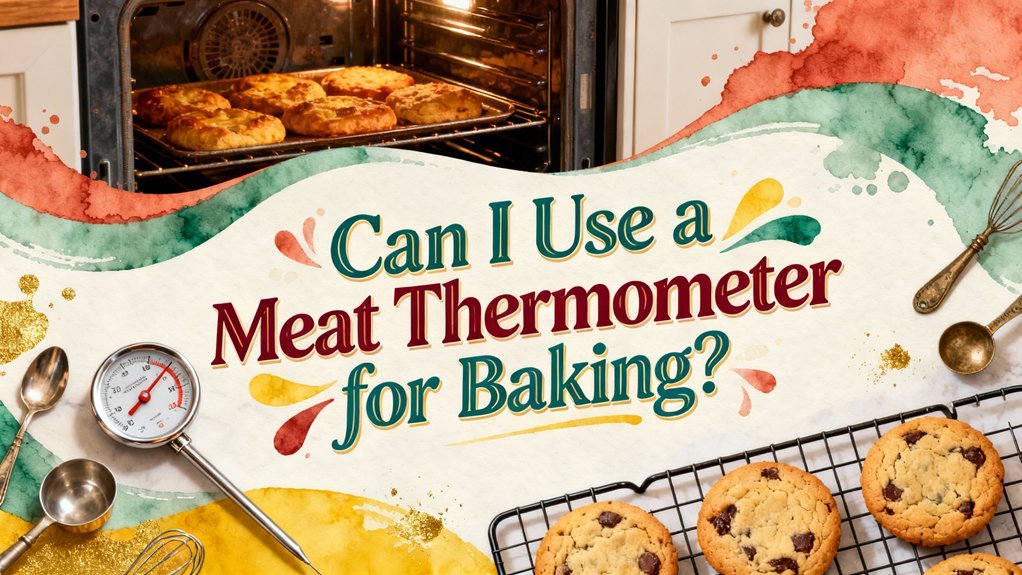
You can use a meat thermometer for baking if it offers ±0.5°F accuracy and covers your needed temperature range. However, you’ll need proper calibration—test it annually using ice bath and boiling water methods. Dial thermometers require calibration nuts; digital models need manufacturer-specific procedures. Make certain correct probe placement to avoid false readings. While meat thermometers work, understanding which specific applications demand pinpoint precision will greatly improve your baking outcomes.
Why Meat Thermometers Work for Baking
Because meat thermometers span a temperature range of -58°F to 572°F, they’re perfectly suited for baking applications that demand precision across diverse products. You’ll find meat thermometer accuracy essential when working with custards, caramel, bread dough, and confections—each requiring specific internal temperatures for ideal results.
You can rely on pinpoint accuracy within seconds to prevent common baking failures like curdling or scorching. Following baking temperature guidelines becomes straightforward when you insert the probe into the thickest section of your product, avoiding structural elements that compromise readings. The fastest response time among digital thermometers ensures you capture accurate readings before heat continues to cook your delicate baking projects. Proper probe insertion depth of ½ inch to 2 inches allows you to monitor temperature accurately across varying batter and dough thicknesses. Always ensure you’re calibrating your thermometer regularly to maintain the accuracy essential for reliable baking results. To achieve consistent results, refer to proper thermometer usage guidelines that ensure optimal performance during your baking process. High-quality instant-read thermometers should read within +/-0.5°F accuracy to ensure your baking temperatures are precise enough for delicate recipes.
Both dial and digital readouts accommodate food thicknesses from ½-inch to 2 inches deep. Whether you’re monitoring oven-proof thermometers throughout cooking or using instant-read types post-oven, you’ll eliminate guesswork entirely. Regular probe placement techniques will help you achieve consistent temperature readings across your baking projects. Wireless meat thermometers designed to withstand oven heat provide flexibility for continuous temperature monitoring throughout your baking process. This analytical approach guarantees consistent, predictable outcomes across all your baking endeavors.
Accuracy Testing and Calibration Methods
Even the most reliable meat thermometer can drift out of calibration over time, so you’ll want to establish a regular testing routine using two straightforward methods: the ice bath test and the boiling water test.
For the ice bath test, submerge your thermometer stem 2 inches into crushed ice and water for 30 seconds. You’ll achieve an accurate 32°F reading regardless of elevation. The boiling water test requires inserting your probe 2 inches into vigorously boiling water, accounting for local atmospheric pressure. Always ensure the thermometer probe is inserted to the notch on the metal part to guarantee proper support and protection of internal components.
Different thermometer types demand varying calibration techniques. Dial thermometers allow adjustment via calibration nuts beneath the head, while digital models require manufacturer-specific procedures. Proper probe insertion techniques are essential for obtaining consistent calibration results across different cooking applications. Oven-safe probe thermometers are specifically designed to remain in meat throughout the cooking process, making them ideal for continuous temperature monitoring during baking applications. Most oven-safe meat thermometers can withstand temperatures up to around 550°F, which provides reliable durability for sustained in-oven use. Premium digital thermometers like the Typhur Gold achieve exceptional accuracy of ±0.5°F, setting the standard for precision in temperature monitoring. If your thermometer reads off by ±5°F or more, you should replace it to ensure better quality for your baking applications. Some digital thermometers cannot be calibrated and may need replacement if they drift out of accuracy. High-quality instant-read thermometers should read within ±0.5°F; bimetal variants within ±2°F. Test annually or after physical damage to maintain precision for baking applications.
Common Mistakes to Avoid When Baking
Many bakers compromise their results by misplacing the thermometer probe, checking temperatures too frequently, or failing to allow adequate stabilization time before reading. Incorrect probe placement in fat, gristle, or bone produces false readings that don’t reflect actual meat doneness. Your temperature timing matters greatly—opening the oven repeatedly drops internal heat by 25-50°F and extends cooking time substantially. Each check releases moisture and disrupts even heat distribution. You’ll also encounter thermometer stabilization issues if you remove the probe prematurely or don’t wait 1-2 minutes for equilibrium. Additionally, you must use oven-safe equipment rated for high-heat applications. Instant-read probes melt if left inside during baking. Finally, you should clean probes thoroughly after raw meat contact to prevent bacterial contamination that compromises food safety. Cheap thermometers often have slow response times that make it difficult to obtain accurate readings quickly during the baking process. Sanitizing the thermometer after each use with hot water and antibacterial soap or alcohol wipes ensures that bacteria from raw meat doesn’t transfer to your baked goods.
Specific Baking Applications for Precision Thermometers
Precision thermometers release accuracy across distinct baking categories—from candy making‘s exacting temperature stages to custards’ narrow safety margins. You’ll find different thermometer types serve specialized purposes within specific temperature ranges. For caramels and fudge, instant-read thermometers prevent scorching by catching doneness points instantly. Custard applications demand ±0.4°F accuracy in lower ranges since even eight-degree deviations cause curdling. Sourdough and artisan breads require monitoring flour, water, and air temperatures for ideal fermentation. Oven air probes verify baking environments up to 900°F, ensuring consistent cake and pastry results. Italian buttercream preparation necessitates thermometer precision during egg warming phases. Similar to how polymerization creates durable coatings in cast iron seasoning, the chemical reactions in baking demand precise temperature control to achieve optimal results. Using a dutch oven for bread baking creates steam-trapping environments that benefit from precise internal crumb temperature monitoring to ensure doneness without over-browning. The gentle, even heat distribution of Dutch ovens makes them ideal for roasting whole chickens alongside vegetables, demonstrating how proper temperature monitoring ensures perfectly cooked results. Proper probe placement and calibration methods ensure your thermometer maintains accuracy throughout multiple baking projects. The WiFi-enabled connectivity allows bakers to monitor temperatures in real-time from multiple locations, preventing overcooking disasters while attending to other kitchen tasks. With dual sensors monitoring both internal temperature and ambient heat, bakers achieve the precision required across all baking applications. You’ll enhance outcomes by matching thermometer capabilities to each application’s temperature requirements and response-time demands.
Advantages of Using a Quality Thermometer in Your Kitchen
While matching thermometer capabilities to specific baking applications establishes a foundation for precision, the broader advantages of investing in a quality thermometer extend throughout your entire kitchen. You’ll achieve cooking consistency across diverse recipes and techniques, eliminating guesswork that compromises results. A reliable thermometer enhances kitchen safety by verifying internal temperatures meet food safety standards, protecting against harmful bacteria like Salmonella and E. coli. You’ll prevent undercooking risks while simultaneously avoiding overcooking disasters that waste ingredients and diminish flavor. Real-time monitoring capabilities enable you to multitask confidently, receiving instant alerts when target temperatures reach completion. Smart thermometers with wireless connectivity allow you to monitor your dishes from anywhere in your home, providing convenience and peace of mind during the cooking process. Digital probe thermometers offer faster and more accurate measurements compared to traditional analog options, ensuring your culinary results meet professional standards. Proper calibration and maintenance of your thermometer ensures consistent accuracy and longevity of the device. Many smart thermometers support multiple probes, enabling you to cook several dishes simultaneously while tracking each one independently. Just as proper seal integrity preserves the quality of stored ingredients over time, quality thermometers ensure precise temperature monitoring throughout your culinary process. For those serious about meal preparation, investing in quality kitchen equipment—similar to choosing vacuum sealing bags for optimal food storage—demonstrates a commitment to food preservation and preparation excellence. Whether you’re baking, roasting, or grilling, you’ll streamline your preparation routine, reduce stress, and consistently deliver perfectly cooked dishes that preserve natural juices and ideal texture.