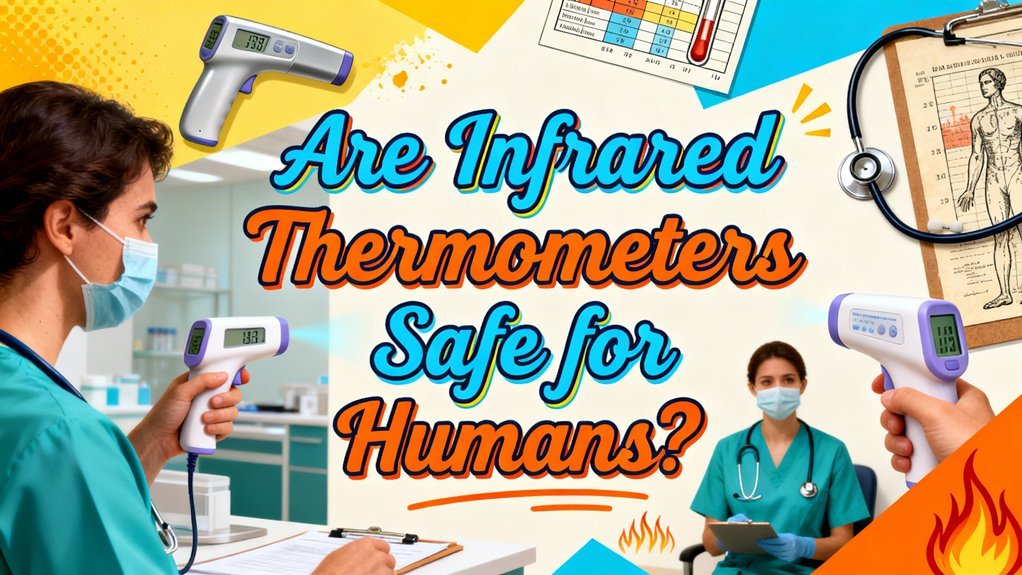
You can safely use infrared thermometers without concern for harmful radiation or neurological damage. These devices emit mid-infrared wavelengths lacking energy to cause cellular harm, and they don’t penetrate skin or bone. Regulatory agencies including the FDA confirm no ophthalmological or neurological risks exist. Consumer-grade models are rigorously tested and classified as Class-II medical devices, reducing cross-contamination compared to traditional methods. To maximize accuracy and safety, you’ll want to understand proper measurement technique and environmental factors affecting results.
How Infrared Thermometers Work
Because all objects above absolute zero emit infrared radiation—a consequence of atomic motion—infrared thermometers can measure temperature without making contact with a surface. You’ll find that these devices operate on fundamental thermometric principles: a lens focuses the infrared energy from your target onto a thermopile detector, which converts radiation wavelength into electrical voltage proportional to thermal energy. The detector absorbs this infrared radiation and generates heat, triggering the thermocouple effect that produces a measurable voltage. Your thermometer’s electronics then calculate the temperature reading in seconds or fractions thereof. This process relies on the Stefan-Boltzmann law, which establishes that radiant power correlates directly to temperature raised to the fourth power, enabling accurate thermal assessment across diverse applications and materials. Similar to how cast iron cookware requires proper handling for optimal performance, infrared thermometers depend on correct technique to deliver reliable results. Understanding your device’s distance-to-spot ratio is critical for ensuring the measurement area stays completely on the intended surface rather than picking up surrounding temperatures. The accuracy of these readings depends significantly on proper use and features, including adjustable emissivity settings that allow for tailored measurements across different surfaces. For optimal performance, it is important to take measurements in stable temperature environments to minimize sensitivity to ambient temperature variations. Non-contact operation also provides hygienic advantages by eliminating the need for direct physical contact during measurement. Like the three-minute rest period recommended for pork after reaching safe internal temperature, allowing infrared thermometers to stabilize ensures the most accurate readings. The measurement and display occur rapidly, providing users with instant temperature feedback without any direct contact with potentially hazardous surfaces.
Debunking Common Safety Myths
Now that you understand the mechanics behind infrared thermometry, it’s worth addressing the widespread misconceptions that have fueled public concern about these devices.
You’ve likely encountered alarming claims about brain damage, harmful radiation, or retinal injury from forehead scanning. These safety misconceptions lack scientific foundation. Infrared thermometers don’t emit X-ray-like radiation or penetrate your skull. They simply detect thermal energy your body naturally emits—comparable to television remote controls. Multiple researchers have confirmed that infrared light cannot penetrate the skull, establishing definitive safety parameters for these devices.
Fact-checking organizations across Europe and Latin America have debunked these myths. The FDA and National Institute of Health and Medical Research confirm these devices pose no neurological or ophthalmological risks. Additionally, touchless thermometers actually reduce cross-contamination compared to traditional contact methods. The FDA has officially endorsed non-contact infrared thermometers as safe devices that can reduce disease transmission risks. Unlike industrial radiation devices, consumer-grade infrared thermometers are specifically designed for human safety], similar to how distance-to-spot ratio is carefully calibrated in cooking applications. The laser pointer on these devices functions only as a visual aiming guide rather than emitting any harmful radiation. Like cooking applications where surface temperature accuracy depends on proper calibration and validation, consumer thermometers are rigorously tested to maintain reliability standards. When used properly according to manufacturer guidelines, infrared thermometers maintain consistent accuracy for routine screening] without presenting any health risks. Repeated use presents negligible health threats. By understanding the actual technology and reviewing authoritative health guidance, you can confidently recognize unfounded safety concerns.
Eye Safety and Radiation Concerns
Why do infrared thermometers raise eye safety concerns when the technology itself poses minimal radiation risks? You’re exposed to mid-infrared wavelengths that lack sufficient energy to cause cellular damage. Unlike industrial IR-A sources, consumer thermometers operate safely within compliance standards established by ICNIRP guidelines.
Your eye exposure from standard thermometers remains negligible because these devices emit minimal infrared radiation at reasonable distances. Non-laser models pose no emission risk whatsoever. Laser-guided versions use low-power lasers that are safe unless aimed directly at your eyes—a scenario unlikely during normal temperature measurement. For infrared thermometers to provide reliable readings, the emissivity setting must be properly calibrated for the material being measured. For industrial workers exposed to intense infrared radiation from metal working and welding, specialized safety spectacles compliant with EN 171 standards provide effective eye protection.
The acute threshold for thermal injury requires sustained high-intensity exposure exceeding 4 W/cm² irradiance. Medical thermometers fall substantially below this limit. Far-infrared radiation emitted by these devices is entirely safe for eyes and body, making them suitable for widespread use in healthcare settings. Like achieving consistent results with proper preparation and technique, using infrared thermometers safely depends on following recommended guidelines during operation. Just as precise temperature control is essential in specialized applications like dabbing concentrates, users should adjust their thermometer settings based on their specific device requirements. Understanding the distance-to-spot ratio specific to your thermometer model helps ensure accurate measurements and safe operation. Healthcare professionals have used these devices widely without reported eye safety incidents when following proper usage protocols.
Proper Usage Guidelines for Accurate Readings
To obtain reliable temperature measurements, you’ll need to prepare your infrared thermometer properly before taking any readings. Implement proper acclimatization techniques by allowing your device 10-30 minutes in the testing environment before use, guaranteeing thermal equilibrium with ambient conditions. Verify that your operating space maintains temperatures between 60.8-104°F with humidity below 85 percent.
For ideal measurement positioning, hold the sensing area perpendicular to your target surface, maintaining consistent distance throughout. Understand your device’s distance-to-spot ratio to guarantee measured areas remain appropriately sized. Eliminate environmental interference by avoiding direct sunlight, drafts, and radiant heat sources. Maintain clear line-of-sight access and keep your lens clean and dry. Remember that infrared thermometers detect infrared radiation emitted from an object’s surface, so ensure your target area is fully exposed to the thermometer’s sensor. Be aware that shiny or polished surfaces can produce inaccurate readings due to their reflective properties. Since these devices measure surface temperatures rather than air temperature, be aware of the limitations when attempting environmental assessments. These devices excel at predictive maintenance and quality control applications where rapid temperature assessments prevent equipment failures. Similar to how a well-ventilated area is essential when using heat-generating tools for cooking, ensure your measurement environment is properly ventilated to maintain optimal device performance. Ensure the forehead area is clean and unobstructed] before measurement to minimize outside influences on temperature readings. These methodical steps assure accurate readings while maximizing measurement reliability and safety during operation.
Accuracy Factors and Environmental Conditions
While proper positioning and lens maintenance establish the foundation for reliable measurements, your infrared thermometer’s accuracy ultimately depends on understanding how environmental conditions and device settings interact with measurement physics. You must calibrate your device with skin emissivity set to 0.98 per ASTM standards, as incorrect emissivity adjustments produce the largest measurement errors. Environmental factors—ambient temperature between 18-32°C, relative humidity from 15-85%, and air movement—significantly influence atmospheric transmission and your readings. Distance-to-spot ratio calibration techniques require your target area to exceed the indicated spot size by approximately 35% to account for optical scatter. Most consumer-grade infrared thermometers achieve an accuracy of ±1 to ±2 degrees Celsius, which is suitable for general screening applications but may require higher-end models for more precise measurements. Studies have demonstrated that 48% to 88% of measurements from various infrared thermometer models fall outside manufacturers’ claimed accuracy specifications. The thermometer’s thermopile detector converts infrared radiation into electrical signals that are then processed to calculate temperature readings. Like wireless probe thermometers that require proper probe placement to ensure accurate temperature readings, infrared thermometers demand careful positioning to deliver reliable results. For advanced temperature monitoring in specialized environments, some modern devices include ambient temperature sensors that measure the cooking environment separately from target readings. In addition to environmental considerations, infrared thermometers excel at verifying refrigerator temperatures and assessing heat distribution within ovens and grills to create consistent cooking environments. You’ll achieve peak accuracy by positioning your thermometer within manufacturer-specified temperature ranges and matching your working distance to your device’s D:S ratio, ensuring precise measurement variables throughout screening operations.
Benefits and Limitations in Practice
Because infrared thermometers detect thermal radiation without emitting any radiation themselves, they’re completely safe for adults, children, and babies when you use them correctly. Your benefit analysis reveals significant practical applications in clinical settings: rapid temperature readings minimize screening delays, while contactless measurement at 3-5cm distance reduces cross-contamination risks substantially compared to oral alternatives. The laser assists in targeting the measurement area to ensure accurate readings.
However, you’ll encounter notable limitations. Achieving accurate readings requires maintaining proper distance and sensor cavity cleanliness. Environmental factors—dust, steam, and reflective heat sources—compromise precision in real-world settings. Similar to how vacuum sealing requires minimizing liquid interference to maintain seal integrity, infrared thermometry requires a clean measurement surface to prevent interference with thermal radiation detection. You must guarantee the forehead remains clean, dry, and unobstructed; facial products, head covers, and excessive clothing alter measurements. Just as specialized vacuum sealers create stronger, more consistent results than improvised methods, professional-grade infrared thermometers deliver superior accuracy compared to consumer models. Though digital models detect faster than analogue versions, operator inexperience still introduces variability, necessitating occasional retakes for verification. All objects emit low levels of infrared radiation, which means factors affecting how that radiation is detected can significantly impact measurement accuracy. Similar to using a meat thermometer, proper probe placement and avoiding interference from surface materials like sweat or makeup ensures reliable temperature detection. Regular testing and maintenance of infrared thermometers helps track any drift in accuracy over time, much like the calibration methods used for other temperature measurement devices.
FDA Endorsement and Healthcare Applications
Non-contact infrared thermometers (NCITs) receive FDA classification as Class-II medical devices under 21 CFR 880.2910, with over 20 models cleared through 510(k) premarket notification in the past three years and conformance to ISO 80601-2-56:2017 standards for safety and essential performance. You’ll find NCITs deployed across healthcare settings, including hospitals and fever-screening stations at points of entry during disease outbreaks. The FDA endorses their non-contact approach for minimizing cross-contamination risks, as supported by CDC recommendations. Clinical evaluations conducted at University Health Centers with over 1,100 subjects demonstrate FDA compliance for fever screening applications. However, the FDA has warned of limitations regarding NCIT performance including measurement location and sensor distance, which can significantly impact accuracy. Proper use and calibration are essential for accurate measurements across all clinical environments, similar to how vacuum sealing technology requires precise pressure control to achieve optimal results. However, you must recognize that clinical evaluations also reveal variable sensitivity at critical temperature thresholds, requiring strict adherence to manufacturer instructions for reliable temperature assessment in healthcare environments. Social media has circulated unfounded fears about eye damage from infrared thermometers, but these concerns lack scientific basis since infrared thermometers measure infrared rays rather than emit laser beams.